COO @ Quorivex Systems
We wanted to automate a few workflows but weren't sure where to start. Lampros helped us cut through the noise and get something useful into production quickly.

CTO @ Teralynx Systems
They picked up our processes surprisingly fast and built around how we already worked instead of forcing us into a new system.

Financial Technology Company
We saw value pretty quickly. A lot of repetitive work that used to take hours every week simply stopped being a problem. Our team could focus on higher-value work instead.
Contact Us
Ready to Ship AI Systems to
Let's align architecture, execution, and delivery from day one.
Published On Oct 06, 2025
Updated On Oct 06, 2025

Billions in liquidity can be meaningless if the protocol has no real users.
Conversely, a protocol with millions of users but no liquidity struggles to offer value or sustainability.
In Web3, protocols that manage to balance both are the ones worth watching.
When we talk about protocols, we mean the smart-contract rules and codebases that define how transactions, markets, staking, lending, swaps, and other actions behave in decentralized systems.
Protocols form the backbone of DeFi, infrastructure, and application interactions in the blockchain world.
Why study them?
Because protocol health is a signal: it tells where developers might build next, where capital flows, and which ecosystems may dominate.
To assess that health, two metrics matter:
TVL reflects capital confidence and liquidity depth; Active Users reflect real adoption, stickiness, and everyday usage.
In this blog, we'll identify the top protocols by both these lenses. We’ll look at key case studies, analyze overlap between the two dimensions, and draw out lessons for builders, DAOs, and investors.
For a complete ecosystem-level view of how protocols across DeFi, infrastructure, and L2s are evolving in 2025, including categories, trends, and metrics, explore our Top Protocols 2025 Guide.
Let’s dive in.
In the introduction, we identified Total Value Locked (TVL) and Active Users as the two most important signals of protocol health.
Let’s unpack what each one means, why they matter, and why they must be viewed together.
On their own, each metric can be misleading. Curve Finance, for instance, still commands one of the deepest liquidity pools in DeFi, yet its user base has remained relatively flat.
On the flip side, Solana-based DEXs record impressive daily wallet activity but manage smaller liquidity pools compared to Ethereum protocols. Neither picture tells the whole story.
That’s why investors, DAOs, and analysts increasingly track both. Some analytics platforms even combine them into composite health scores, weighing capital depth against real engagement to provide a fuller picture of long-term sustainability.
TVL shows where the money is, while Active Users show where the people are.
A protocol only becomes durable when both metrics align. And that’s the lens we’ll use in the next section, where we define how we ranked the leaders.
Before we look at the leaders, it’s important to explain how these rankings were built.
Protocol metrics can be noisy, and without a clear method it’s easy to misread the data. Here’s the approach we used to balance both liquidity depth and real adoption.
We relied on multiple well-known analytics platforms to avoid bias from a single source:
By layering these sources, we reduce the chance of misreporting or overstatement.
Not every spike in TVL or user count tells the full story. We applied a few filters to focus on sustainable activity:
All data points are based on the latest available monthly snapshot as of September 2025, at the time of writing. Since these numbers change quickly, the methodology matters more than the specific values.
This process ensures our rankings highlight protocols that combine liquidity confidence with real adoption.
With that framework set, let’s look at the protocols holding the deepest pools of capital today.
With methodology and metrics in place, let’s examine which protocols currently command the deepest capital pools.
These case studies incorporate real TVL from DefiLlama and Active users from Token Terminal. Because TVL& Active users are dynamic, we’ll note the snapshot timing.
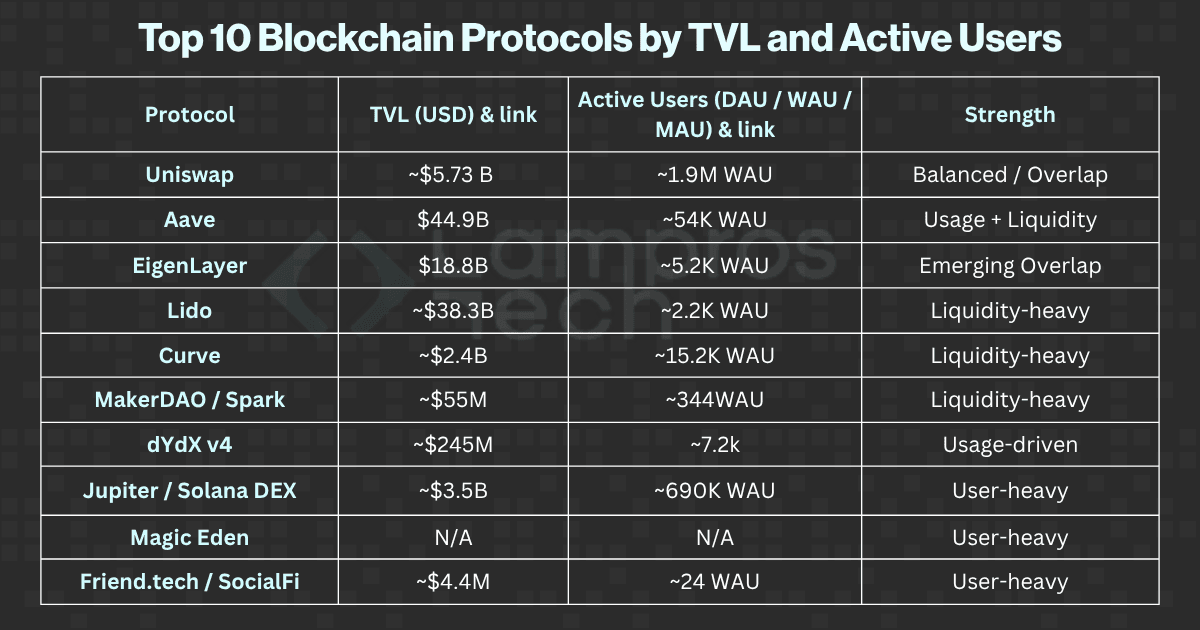
The table highlights how liquidity and adoption rarely sit in the same place. Each protocol leans toward one strength, with only a few managing to bridge both.
Protocols like Lido, Aave, Curve, and MakerDAO dominate in TVL, showing deep institutional confidence and composability across DeFi. Their capital depth gives them resilience, but their user numbers are comparatively modest.
This makes them a stable infrastructure but less retail-driven.
Jupiter, Magic Eden, and Friend.tech demonstrate the opposite. They generate massive wallet activity and engagement but attract less locked value.
They are critical for adoption and onboarding, but without deep liquidity their sustainability can be tested in volatile markets.
Uniswap and EigenLayer stand out as rare cases where liquidity and users converge. Uniswap combines billions in liquidity with millions of active wallets, while EigenLayer pairs $18B+ in restaked ETH with thousands of engaged operators and delegators.
These protocols show what long-term resilience looks like in Web3 capital that isn’t idle and adoption that isn’t shallow.
Liquidity without users risks stagnation, while users without liquidity risk collapse. The strongest protocols are those that align both, making overlap the new benchmark for protocol health in 2025 and beyond.
Uniswap is the leading decentralized exchange (DEX), deployed across Ethereum and L2s.
Values: ~$5.73B TVL and ~1.9M weekly active users (Sept 30, 2025).
What this suggests: One of the rare overlap leaders, Uniswap balances liquidity and adoption better than almost any other protocol.
Strengths:
Weaknesses:
Takeaway: Uniswap is the benchmark for DEX adoption and liquidity, setting the pace for the industry.
Aave is a multichain lending and borrowing protocol.
Values: ~$44.9B TVL and ~54K WAU (Sept 30, 2025).
What this suggests: Aave is liquidity-rich and highly interactive, with active lending and borrowing cycles across chains.
Strengths:
Weaknesses:
Takeaway: Aave is one of the most sustainable DeFi protocols, combining capital depth with real user activity.
EigenLayer is a restaking protocol that allows staked ETH and other assets to secure additional services.
Values: ~$18.8B TVL and ~5.2K WAU (Sept 30, 2025).
What this suggests: EigenLayer has become a capital magnet while building an active network of operators and delegators.
Strengths:
Weaknesses:
Takeaway: EigenLayer is pioneering a new model where liquidity and participation converge, though it’s still early.
Lido is the largest liquid staking protocol, primarily for Ethereum.
Values: ~$38.3B TVL and ~2.2K WAU (Sept 30, 2025).
What this suggests: Lido dominates ETH staking but has limited direct user interaction, most activity is passive.
Strengths:
Weaknesses:
Takeaway: Lido is liquidity-heavy by design, its strength lies in stability, not in user activity.
Curve is a DEX specializing in stablecoin swaps with low slippage.
Values: ~$2.4B TVL and ~15.2K WAU (Sept 30, 2025).
What this suggests: Curve retains capital efficiency for stablecoins but struggles with broader user adoption.
Strengths:
Weaknesses:
Takeaway: Curve remains a backbone for stablecoin liquidity but lags in expanding its user base.
MakerDAO is a lending protocol and stablecoin issuer (DAI), increasingly focused on real-world assets (RWAs).
Values: ~$55M TVL and ~344 WAU (Sept 30, 2025).
What this suggests: MakerDAO commands institutional-scale liquidity but minimal direct wallet interaction.
Strengths:
Weaknesses:
Takeaway: MakerDAO is liquidity-first, with strength in institutional adoption but weak retail activity.
dYdXv4 is a decentralized perpetuals exchange, now migrated to its own appchain.
Values: ~$245M TVL and ~7.2K WAU (Sept 30, 2025).
What this suggests: A trader-focused protocol with modest liquidity but loyal niche adoption.
Strengths:
Weaknesses:
Takeaway: dYdX v4 is usage-driven, not capital-heavy, but sticky with its pro trading community.
Jupiter is a leading aggregator on Solana, routing trades across liquidity sources.
Values: ~$3.5B TVL and ~690K WAU (Sept 30, 2025).
What this suggests: Jupiter thrives as a user-heavy platform, benefiting from Solana’s speed and low fees.
Strengths:
Weaknesses:
Takeaway: Jupiter showcases how user-first ecosystems can scale adoption faster than liquidity.
Magic Eden is a leading NFT marketplace, originally on Solana, now multichain (ETH, Polygon, Bitcoin ordinals).
Values: No DeFi-style TVL; consistently among top NFT protocols by wallets.
What this suggests: Magic Eden shows strong adoption in NFTs, where activity metrics matter more than TVL.
Strengths:
Weaknesses:
Takeaway: Magic Eden is a prime example of user-driven adoption beyond DeFi.
Friend.tech is a SocialFi app enabling tokenized social interactions.
Values: ~$4.4M TVL and ~24 WAU (Sept 30, 2025).
What this suggests: Friend.tech illustrates the volatility of SocialFi, strong at launch but fragile over time.
Strengths:
Weaknesses:
Takeaway: Friend.tech highlights SocialFi’s potential but also its fragility, user-heavy but unsustainable without deeper capital flows.
The strongest protocols are not those that win in just one metric, but those that perform across both. Uniswap, Aave, and EigenLayer illustrate what true protocol resilience looks like.
Next, we’ll zoom out and explore the broader trends driving why these overlaps emerge and how they’re shaping the future of DeFi and Web3 protocols.
In the last section, we saw how only a few protocols manage to balance both liquidity and adoption.
The question is: why do they succeed where others fall short?
The answer lies in a set of emerging DeFi trends that are reshaping how protocols attract capital, engage users, and sustain growth.
These are not short-lived narratives; they are structural shifts defining the next generation of Web3 leaders.
Protocols like EigenLayer have introduced a new design space by letting staked ETH and other assets secure additional services. This transforms idle capital into productive collateral.
Projects like MakerDAO and Ondo Finance are bringing treasury bills, bonds, and off-chain collateral into lending protocols.
Chains like Solana show that speed and near-zero fees directly correlate with high daily active users.
Beyond faster chains, trading models themselves are evolving, as highlighted in our Top DEX Trends in 2025 blog. Decentralized exchanges are shifting toward intent-based execution and liquidity automation.
Uniswap v4’s “hooks” and Solana’s Jupiter aggregator embody this shift, enabling users to define desired outcomes while the protocol optimizes execution behind the scenes.
Social finance apps are proving that engagement can be just as valuable as capital.
Friend.tech, for example, peaked with tens of thousands of daily active wallets and over $50M in TVL during its growth cycles.
As institutions enter DeFi, compliance is becoming a competitive edge.
Across these shifts, one theme stands out: top protocols succeed when they align capital and adoption through innovation.
These emerging DeFi trends explain why certain protocols are overlap leaders. They aren’t chasing vanity metrics; they’re creating durable ecosystems where liquidity and adoption reinforce each other.
Next, we’ll break down what this means in practice for builders, DAOs, and investors who want to position themselves in this evolving landscape.
The trends we’ve outlined don’t just explain why today’s leading protocols succeed; they also signal how different stakeholders in Web3 should adapt.
Whether you’re building, governing, or allocating capital, the ability to read both liquidity depth and user adoption is becoming non-negotiable.
Builders who prioritize real user adoption and UX will attract liquidity over time, as capital follows usage.
DAOs that combine effective governance with capital efficiency are best positioned to retain both liquidity providers and users.
For a deeper exploration of how decentralized governance frameworks evolve in parallel with liquidity and adoption, read our blog on Top Governance Protocols.
The most attractive investments are protocols where liquidity and adoption reinforce each other, creating compounding network effects.
Each stakeholder group has a different lens, but the common thread is clear: durable protocols are those where capital and adoption converge. Builders can design for it, DAOs can govern for it, and investors can allocate toward it.
Next, we’ll close with a conclusion that pulls these insights together and frames the bigger picture: why liquidity and adoption, together, are the new gold standard for protocol success.
For a long time, the scoreboard of Web3 relied on a single number. First, it was Total Value Locked (TVL) as the defining benchmark.
Then came daily active users (DAU) as a way to measure adoption. Both remain important, but in today’s ecosystem, neither alone signals true protocol health.
The protocols shaping the next phase of Web3 are the ones that unite deep liquidity with real user activity:
Across the industry, the same pattern repeats.
Restaking, RWAs, high-performance chains, intent-based trading, SocialFi, and compliance are not just emerging DeFi trends; they are structural shifts pushing protocols to turn liquidity into adoption and adoption into defensible liquidity.
The takeaway is clear:
Looking ahead, as modular ecosystems expand and cross-chain activity deepens, protocols will be judged not just on scale but on how effectively they align capital and adoption across networks.
For teams navigating this landscape, whether building, governing, or investing, the lesson is simple: focus where liquidity and users converge. That is where the long-term value lies.
At Lampros Tech, we help teams cut through the noise, design token-efficient systems, and build for the protocols that last.
Whether you’re building a new DeFi protocol, optimizing liquidity systems, or integrating on-chain infrastructure, our team helps you design for scalability, efficiency, and verifiable adoption. To go deeper, explore our DeFi services.

TVL (Total Value Locked) measures the total amount of crypto assets deposited into a protocol’s smart contracts, such as in staking, lending, or liquidity pools. It reflects capital confidence and liquidity depth. A higher TVL typically indicates trust, adoption, and active participation in a DeFi ecosystem.
As of September 2025, the top blockchain protocols by TVL include:
These protocols lead in capital depth and integration across multiple chains, according to DefiLlama.
Protocols leading in active wallet usage include:
These platforms excel in accessibility, low fees, and high on-chain engagement, according to Token Terminal and Artemis Analytics.
TVL shows where capital flows; active users show where real adoption happens. A protocol with both liquidity and consistent user engagement, like Uniswap or EigenLayer, demonstrates long-term sustainability. Liquidity without users risks stagnation, while user-heavy platforms without liquidity struggle to scale.
Six trends define 2025’s leading blockchain protocols:
DEX Infrastructure
Talk to our team about building intent-based, cross-chain, and MEV-safe trading systems.
Let’s Talk