
COO @ Quorivex Systems
We wanted to automate a few workflows but weren't sure where to start. Lampros helped us cut through the noise and get something useful into production quickly.

CTO @ Teralynx Systems
They picked up our processes surprisingly fast and built around how we already worked instead of forcing us into a new system.

Financial Technology Company
We saw value pretty quickly. A lot of repetitive work that used to take hours every week simply stopped being a problem. Our team could focus on higher-value work instead.
Contact Us
Ready to Ship AI Systems to
Let's align architecture, execution, and delivery from day one.
Published On Oct 25, 2025
Updated On Oct 25, 2025

Five years ago, choosing a blockchain protocol meant comparing block times and bridge designs.
In 2025, it’s a strategic decision, one that defines your product’s scalability, security, and economics.
Get it right, and you launch faster with fewer trade-offs. Get it wrong, and you’re locked into technical debt that’s hard to escape.
This guide cuts through the noise to reveal what truly signals leadership in 2025, not hype, not headlines.
We break down blockchain ecosystems through a unified lens of adoption, governance, security, economic quality, and ecosystem reach.
Over the next sections, you’ll see:
Let’s decode how to measure blockchain performance and see which protocols are truly leading the next era of Web3.
In 2025, blockchain isn’t just about faster block times or cheaper fees; protocol choice is a strategic foundation.
It defines scalability, security, economics, and ecosystem reach for every product built on it.
Billions in liquidity, governance power, and developer activity now concentrate in a handful of leading ecosystems, making selection a high-stakes decision.
Five dimensions shape leadership today:
Why this matters:
2025’s leaders emerge where these signals align:
Protocol choice in 2025 isn’t technical; it’s strategic.
Teams that measure signal, not noise, build resilient ecosystems. The ones that don’t, inherit fragility.
Let’s deep dive into the metrics, frameworks, and ecosystems that define blockchain leadership in 2025 so you can choose not just what’s popular, but what endures.
Not all metrics tell the full story.
TVL spikes, wallet counts, and daily active users might grab headlines, but they often mask temporary incentives or inconsistent data across chains.
To cut through this noise, we focus on metrics that hold up under scrutiny: those grounded in verifiable data, consistent across ecosystems, and reflective of real usage and sustainability.
Our evaluation draws on trusted analytics sources from -
From these foundations, we built a framework designed to measure blockchain ecosystems holistically, not just by numbers, but by network health and adaptability.
It rests on five core pillars that reveal where real strength lies:
Together, these dimensions create a clear and comparable framework to evaluate how protocols perform and, more importantly, how they sustain.
Each pillar is explored in detail below to help you see what drives true protocol maturity in 2025.
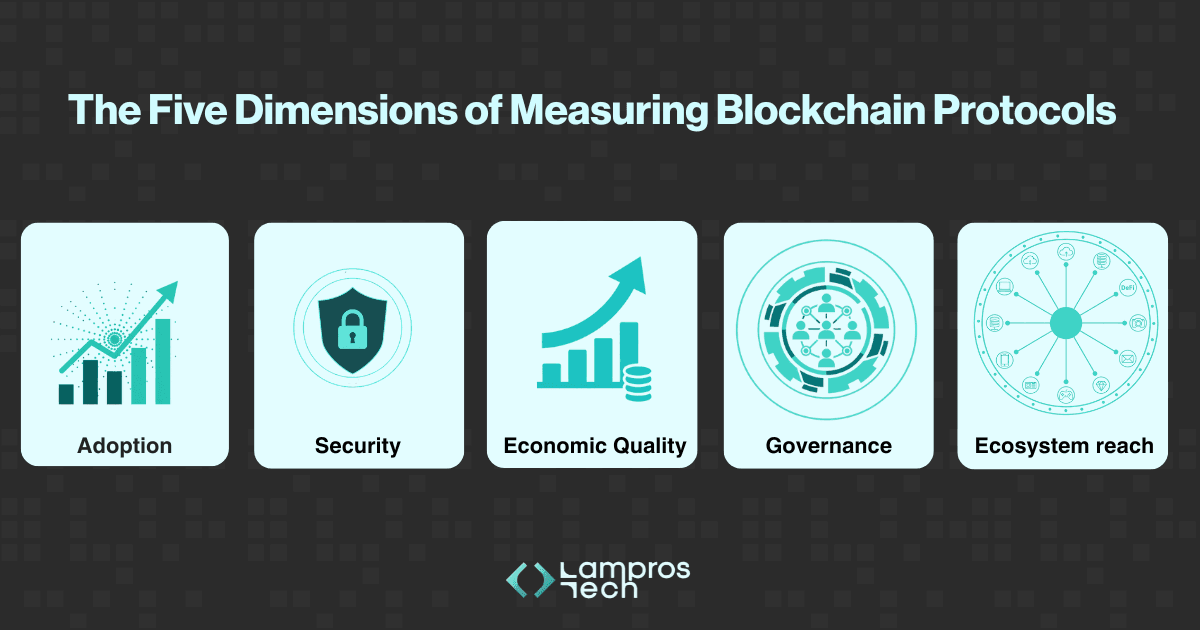
Adoption isn’t about counting wallets; it’s about whether users are willing to pay for value and whether capital actually stays committed.
Vanity metrics can be inflated, but these signals reveal real traction:
These adoption metrics don’t just show activity, they reveal where real network gravity is forming.
To identify the most resilient ecosystems, we measured and compared protocols using standardized adoption signals, including transaction fee trends, liquidity retention, and value secured across chains.
See how each protocol performed in our in-depth analysis: Top DeFi Protocols in 2025.
But adoption alone doesn’t ensure resilience. Once users and capital arrive, governance determines whether a protocol grows or stalls.
Governance has evolved from token voting into structured, data-informed coordination.
A protocol’s adaptability depends on how efficiently its community proposes, debates, and executes change.
Strong governance isn’t just democratic; it’s operationally sound.
We measure:
Protocols like Arbitrum DAO, Optimism Collective, and Uniswap DAO demonstrate how distributed decision systems can balance speed, accountability, and legitimacy, ensuring treasuries, upgrades, and incentives align with long-term growth.
Governance determines how resilient an ecosystem remains when market conditions shift. We have explored these frameworks in depth in our blog: Governance Protocols in 2025.
But governance alone isn’t enough. Clear direction means little without the strength to uphold it.
That’s where the next pillar of Security steps in, anchoring every decision to a foundation of trust and confidence in execution.
Security in 2025 isn’t a simple yes or no. It’s no longer just about audits or bug bounties, it’s about how trust is architected.
Every protocol today makes deliberate design choices that balance scalability, cost, and decentralization. These choices define how secure the system truly is under pressure.
At the heart of these trade-offs lie two critical components: the proof system and the data availability (DA) model.
In short, it determines who can check the network’s past and how resistant it is to censorship or manipulation.
A protocol’s security design sets the risk boundary for everything built on it.
Transparent proofs and reliable DA layers reduce vulnerabilities across the entire ecosystem, while weaker models can expose builders and users to hidden risks under stress.
We’ve explored these proof and DA design tradeoffs in depth in Security Protocols in 2025.
However, even the most secure architecture requires a robust economic foundation to remain viable, and that’s where the next pillar, Economics, comes in.
Adoption only matters if it creates real, sustainable economics.
A protocol that generates activity but fails to capture revenue is exposed once token incentives fade or liquidity shifts elsewhere.
Predictable, recurring revenue builds durability. And fragile models collapse once incentives stop, while sustainable fee capture separates temporary traction from long-term competitiveness.
We have explored these patterns in our blog on Top Protocols by TVL and Active Users in 2025.
A strong economic base provides stability. But it’s reach to expand across chains, ecosystems, and partners that unlocks the next phase of growth.
A protocol’s true influence extends beyond its native chain.
Ecosystem reach measures how far a protocol’s integrations, partnerships, and deployments spread across the blockchain landscape.
This includes:
In 2025, reach defines credibility. Protocols that interconnect ecosystems attract developers, users, and liquidity faster, creating compounding growth across the modular stack.
Other signals like verified contract calls, operator counts, or incident logs are valuable, but not consistently tracked across all ecosystems.
We have explored these patterns in our blog on Interoperability Protocols in 2025.
With these five pillars - adoption, developer activity, security, and economic quality, we now have a consistent way to evaluate blockchain ecosystems.
The next step is to see which protocols actually lead across these dimensions.
If DeFi revealed where liquidity forms and governance showed how decisions unfold, the next question is clear: where is all that activity concentrating in 2025?
That’s what the Master Snapshot captures.
Rather than chasing old metrics ICOs in 2017, TVL charts in 2020, or NFT spikes in 2021, it focuses on the signals that truly matter today: adoption, governance, security, economic quality, and ecosystem reach.
It’s the wide-angle view of blockchain showing, at a glance, which ecosystems are gaining momentum and which are losing ground.
Every figure here comes from trusted sources like Token Terminal, DeFiLlama, L2BEAT, Electric Capital, and Artemis.
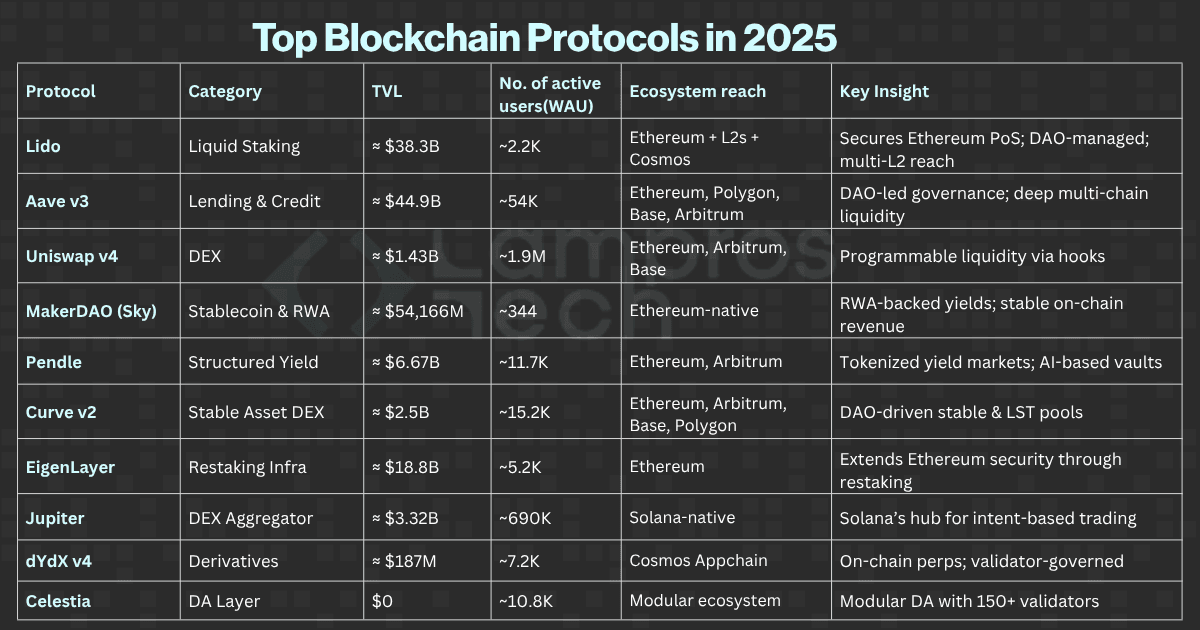
Takeaways:
Capital doesn’t stay idle on base layer moves, earns, and compounds through DeFi.
This is where adoption turns into measurable demand and liquidity transforms into lasting utility.
In 2025, DeFi isn’t just where users transact; it’s where protocols prove durability through swaps, credit markets, and yield systems that keep the ecosystem alive.
Let’s explore the protocols defining this maturity phase of DeFi in 2025.
Five years ago, the DeFi story was about whether liquidity would show up at all.
Incentives did the heavy lifting, but they also revealed how fragile ecosystems were when rewards ran dry.
In 2025, DeFi doesn’t just attract liquidity, it anchors it. A handful of protocols now function as core financial infrastructure, routing billions in credit, swaps, staking, and yield every day.
They’ve evolved from standalone dApps to execution layers and liquidity backbones for entire ecosystems.
The real question now isn’t who can grow fast, it’s:
“Which protocols can hold liquidity, compound it, and build around it?”
Many lists talk about “top DeFi projects” using surface-level metrics like TVL or hype cycles. But short-term spikes don’t reveal the real leaders.
We use a structured framework designed to filter signal from noise.
For comparability, our analysis zeroes in on five core dimensions:
This framework lets us evaluate who leads the infrastructure stack, not just who trends on dashboards.
In 2025, DeFi isn’t a single vertical; it’s an interconnected stack. Every protocol that matters fits into one of four strategic layers:
Each layer has a small number of dominant protocols setting the pace. Understanding these layers isn’t optional; it’s how you spot where ecosystems are consolidating and where builders should plug in.
Explore the dominant protocols shaping each layer in Top DeFi Protocols in 2025.
Here is the snapshot of the top defi protocols -
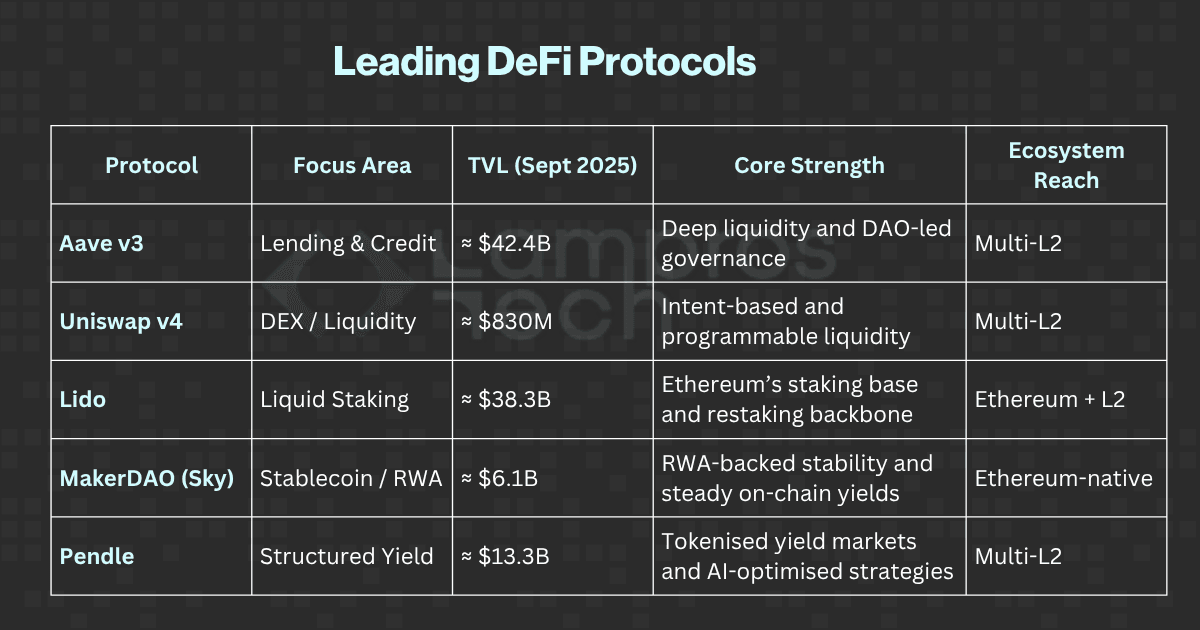
Liquidity hubs are powerful on their own, but their real strength emerges when they’re connected.
That’s where interoperability protocols come in, linking ecosystems through bridges, messaging layers, and shared security frameworks that enable seamless multi-chain movement.
In 2025, blockchain’s biggest challenge isn’t building chains, it’s connecting them.
With liquidity across Ethereum, Solana, and Cosmos, the real question became:
“How do we make these systems talk securely?”
That’s where interoperability protocols now lead. They’ve evolved from fragile bridges into modular coordination layers that route assets, data, and intent across ecosystems.
These networks power the composability that DeFi, rollups, and modular blockchains depend on.
Unlike surface metrics like “number of chains connected,” our approach measures how deep and verifiable those connections are.
Our evaluation framework examines five critical dimensions that determine true cross-chain reliability:
This framework distinguishes protocols that merely transfer assets from those that synchronize state, turning blockchains into a unified computation network.
Together, these systems form the operating fabric of modular Web3, where assets, data, and logic move seamlessly.
Here is the snapshot of the top interoperability protocols -
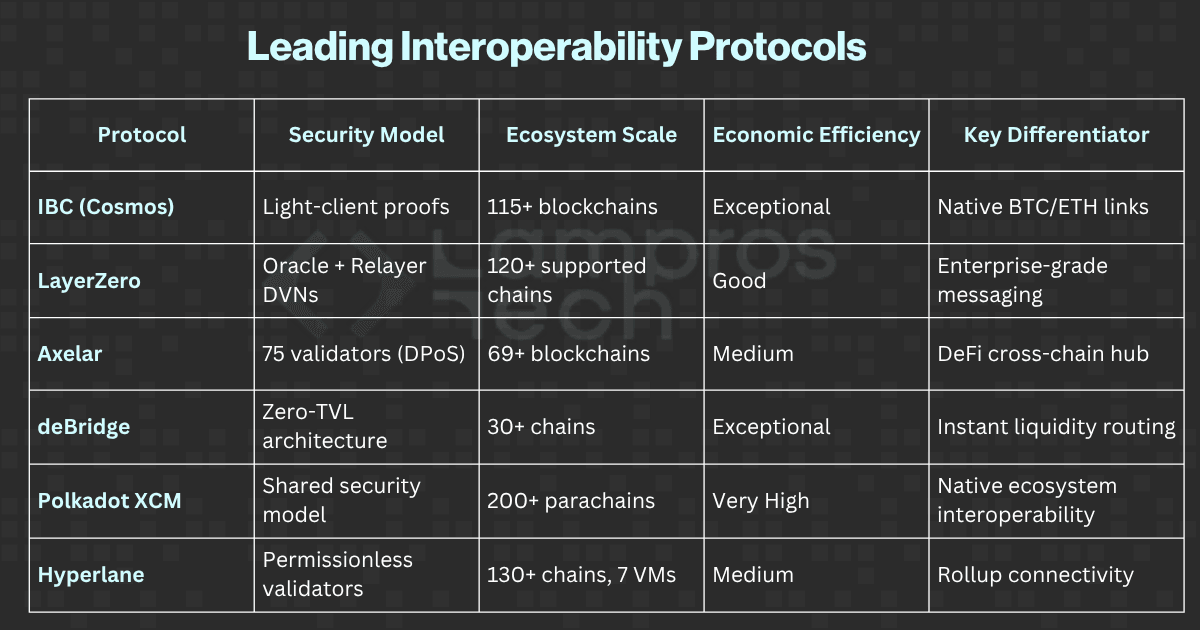
Takeaways:
We examine these trade-offs in greater depth, from validator routing to shared security economics, in our extended analysis, Interoperability Protocols in 2025.
But interoperability is only as strong as the security models that sit underneath it. Cross-chain connections don’t matter if proofs fail, if data can’t be verified, or if operators aren’t trusted.
That’s why the next layer to examine is security protocols, the mechanisms that turn consensus into confidence, from proof systems to restaking markets.
In 2025, security isn’t a checklist; it’s an architecture.
Every blockchain stands or falls on how it verifies truth, manages trust, and sustains reliability under pressure.
Early security relied on audits and bug bounties.
Today, it spans proof systems, restaking networks, and data availability (DA) layers that define how far an ecosystem can safely scale.
Security has evolved from reactive defense to a proactive design, an integral layer of blockchain infrastructure.
Every DeFi trade, DAO vote, and cross-chain message depends on the guarantees provided by these underlying systems.
Protocols that align scalability with verifiable safety are shaping how Web3 scales securely in 2025 and beyond.
Our evaluation focuses on how protocols achieve verifiable safety and scalable guarantees across three core mechanisms:
These architectures together define a network’s resilience, ensuring that blockchains remain secure, scalable, and composable under real-world load.
Here is the snapshot of the top security protocols -
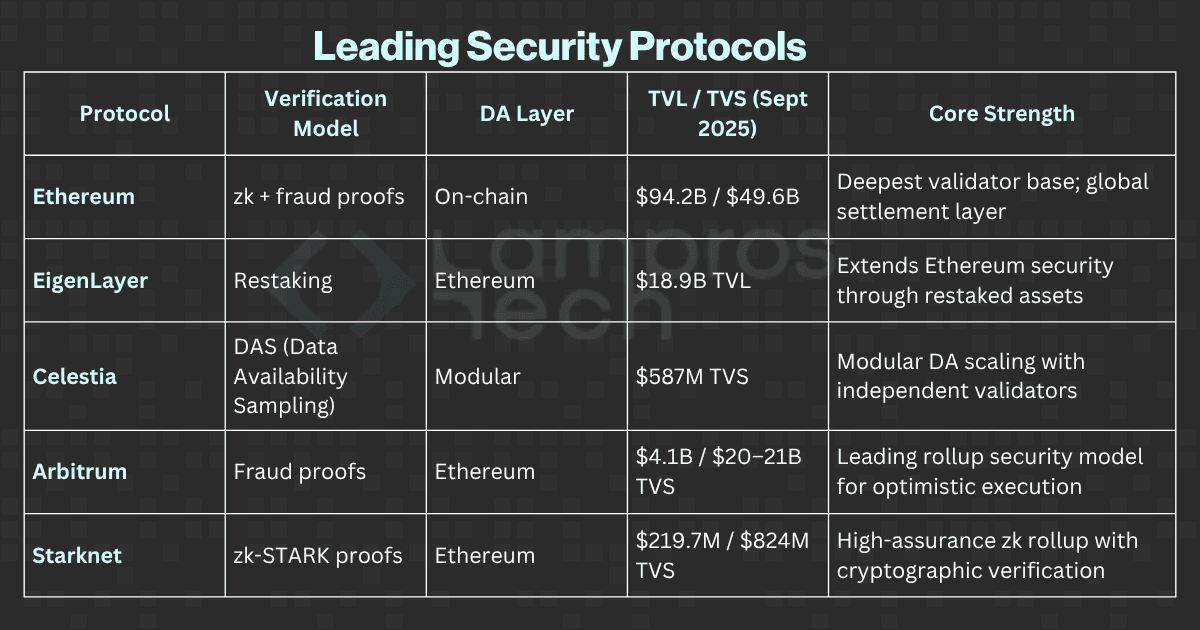
Takeaways:
Security in 2025 isn’t a single system it’s a network of assurances that define how blockchains coordinate, scale, and sustain trust.
We have explored these models and their tradeoffs in greater depth from proof systems to restaking and modular DA in our blog on Security Protocols in 2025.
If security protects blockchains from failure, governance keeps them evolving.
In 2025, decentralised governance has become the operational backbone of major ecosystems driving upgrades, managing treasuries, and sustaining long-term growth.
Here’s how governance protocols are shaping the next phase of coordination in Web3.
In 2025, blockchain governance has evolved from token voting to institutional-grade coordination.
Every network is more than code; it’s a living community making continuous decisions about upgrades, funding, and legitimacy.
Early governance relied on one-token-one-vote systems that worked for small projects but broke down at scale.
Today, the most advanced protocols combine delegate systems, bicameral models, and even AI-assisted tooling to balance efficiency, representation, and transparency.
Governance isn’t just about who votes, it’s about how ecosystems adapt without losing decentralization.
Our evaluation looks beyond voter counts and focuses on how decisions translate into sustained progress.
The framework considers:
Together, these factors reveal how effectively each ecosystem balances decentralization with decision-making speed.
Here is the snapshot of the top governance protocols -
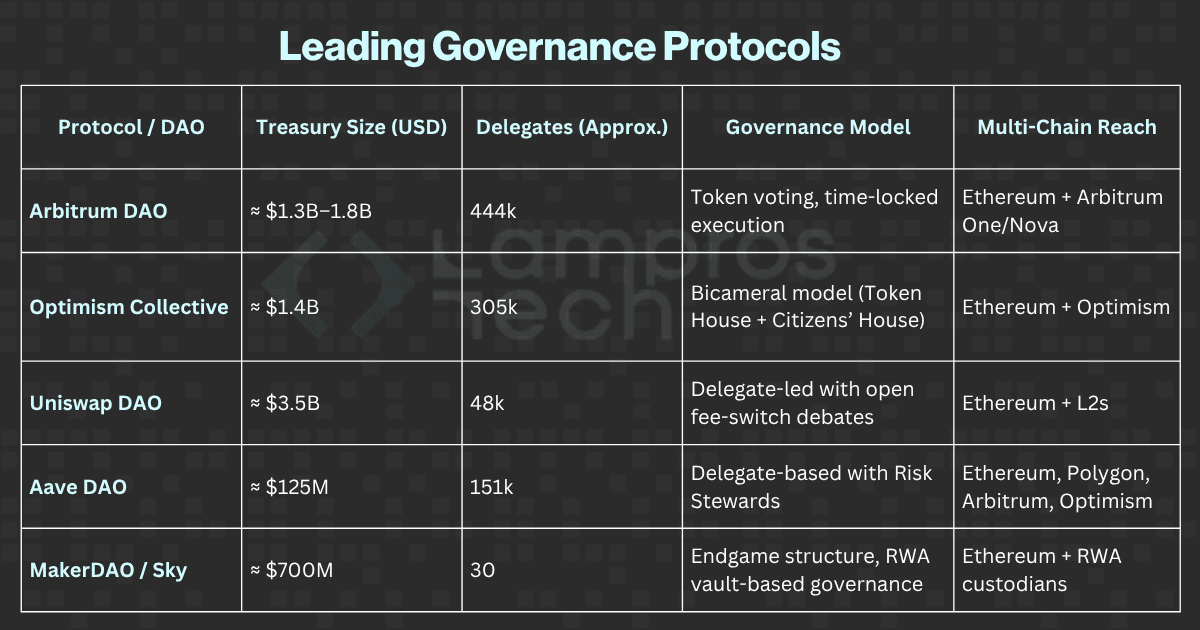
Takeaways:
We have explored voting mechanics, delegate concentration, and legitimacy experiments in our blog on Governance Protocols in 2025.
Today governance sets the rules, but traction validates them. At the end of the day, protocols rise or fall on where capital and users actually stick.
To close, we look at TVL and active users, the clearest signals of staying power in 2025.
Capital and users are the ultimate reality check. Fees, governance, and security models all matter, but without liquidity and daily activity, protocols don’t survive.
In 2025, two signals dominate this conversation: Total Value Locked (TVL) and Active Users.
Our analysis examines how capital and activity reinforce each other across ecosystems.
Protocols that pair deep liquidity with real usage signal economic resilience — the ability to attract, retain, and compound participation even when incentives fade.
This year, liquidity and user activity have expanded beyond Ethereum’s L1 dominance.
While DeFi leaders like Aave and Lido continue to anchor deep liquidity, Uniswap and Jupiter demonstrate how active user engagement drives real on-chain velocity.
Meanwhile, EigenLayer’s restaking and capital concentration highlight how new infrastructure primitives are reshaping both liquidity distribution and network utility.
Here is the snapshot of the top TVL & Active users protocols -
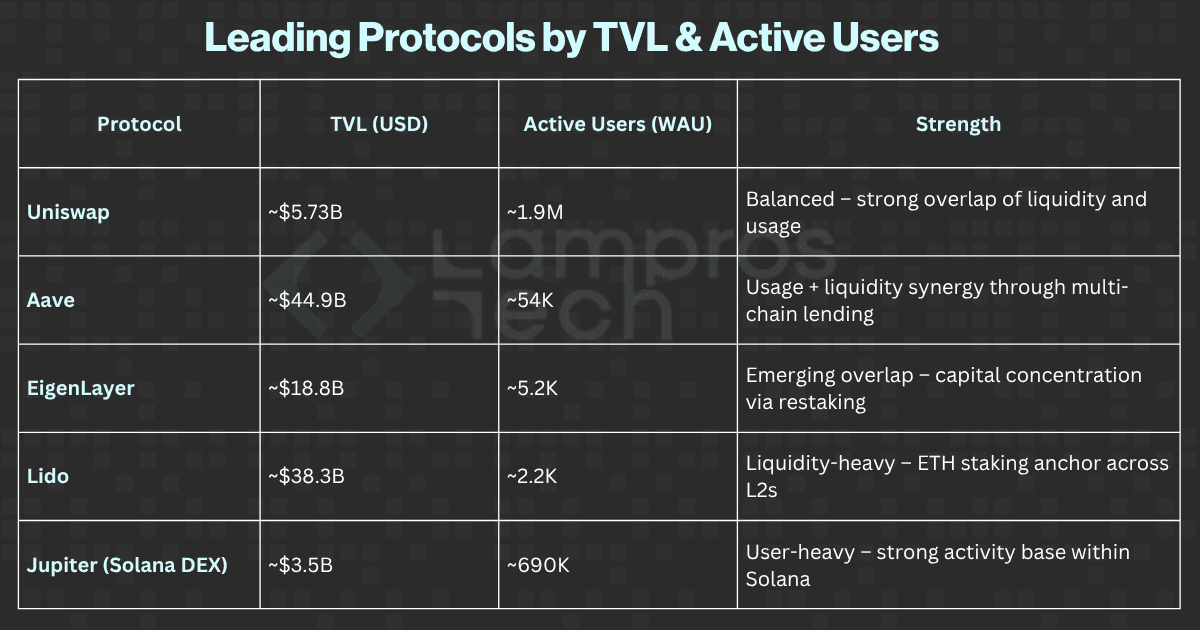
Takeaways:
For teams, these metrics show where to deploy first to reach meaningful liquidity and audience.
We expand on more details behind TVL, active addresses, and demand concentration in our blog on Top Protocols by TVL and Active Users in 2025.
Liquidity and users define traction, but the real engines driving both lie inside decentralized exchanges. The next section dives into the protocols shaping this evolution.
If liquidity is DeFi’s heartbeat, decentralised exchanges (DEXs) are the arteries that keep it flowing across ecosystems.
By 2025, DEXs will have evolved far beyond simple swap engines; they’ll become multi-chain, intelligent liquidity networks shaping how value moves, markets form, and execution scales across blockchains.
The early DEX era revolved around incentive mining and liquidity farming. That phase is over.
Today, the leaders compete on execution quality, cross-chain routing, and AI-driven optimization, transforming DeFi from yield-driven speculation to self-sustaining market infrastructure.
Our evaluation framework looks at how each exchange combines liquidity depth, routing intelligence, and composability to deliver efficiency across ecosystems.
Metrics include:
The leaders of 2025 demonstrate how decentralized liquidity can rival and often surpass centralized exchange performance.
Snapshot: Leading DEXs in 2025-
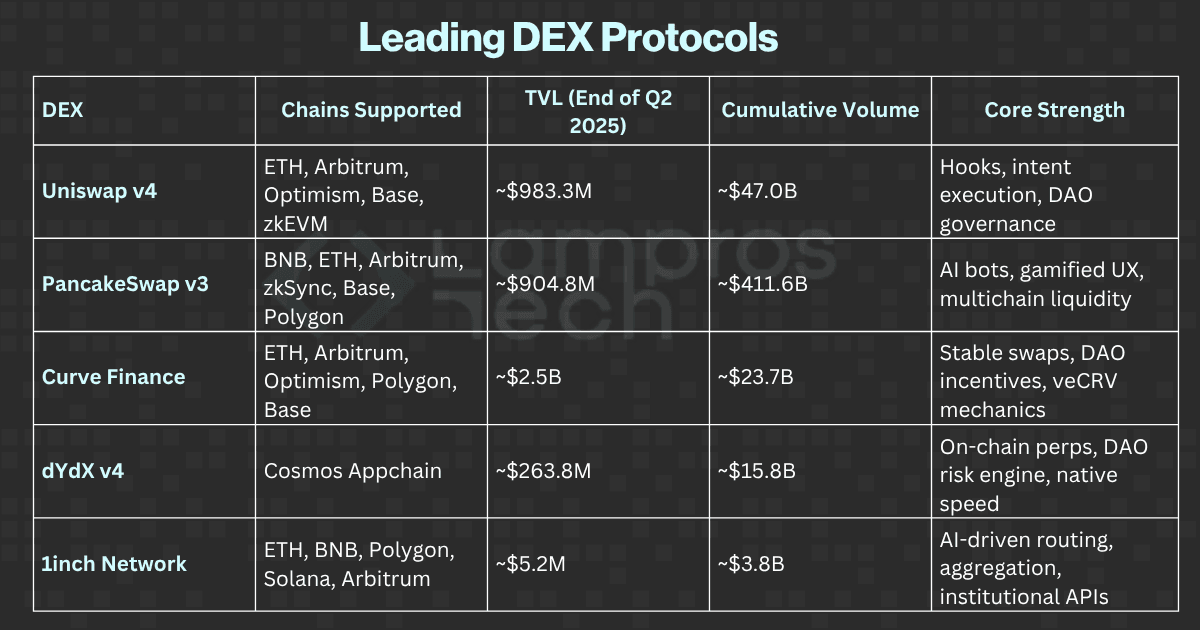
Key Insights
DEXs now represent more than trading venues; they are DeFi’s execution layer, powering liquidity, composability, and innovation across every major chain.
We have explored detailed performance metrics, emerging DEX architectures, and market concentration in our full analysis: Top Decentralised Exchanges in 2025.
From swaps to security, every protocol we’ve covered forms part of a larger system.
To understand where blockchain is truly heading, we need to look at how these pieces fit together.
No single metric defines leadership in 2025.
Interoperability, security, governance, liquidity, and adoption are no longer separate domains; they are interconnected layers of the same ecosystem decision.
Selecting a protocol today means evaluating how these signals reinforce each other, not chasing a single performance metric.
When these layers are viewed together, one truth becomes clear: protocol choice in 2025 is strategic, not technical.
It shapes your time to market, ability to adapt, and long-term scalability.
The strongest ecosystems from Ethereum’s modular architecture to Solana’s monolithic performance and Arbitrum’s L2 efficiency succeed because they align all five dimensions of blockchain maturity.
Each decision, from where liquidity lives to how governance operates, defines the foundation of the next generation of Web3 products.
Understanding these interdependencies is what separates teams that scale sustainably from those that stall under complexity.
At Lampros Tech, we help teams navigate these tradeoffs with clarity from protocol selection to execution. Explore our Defi services or reach out to see how we can support your next build.

In 2025, protocol selection is no longer just a technical choice; it’s a strategic business decision. The right protocol determines your project’s scalability, cost efficiency, and long-term viability. Choosing well means faster deployment and lower risk; choosing poorly can lead to governance lock-ins, high fees, or limited user reach.
Lampros Tech’s framework measures protocols across five pillars of performance:
Each metric is backed by verified data sources like DeFiLlama, Token Terminal, Artemis, L2Beat, and DefiSafety.
Ethereum continues to anchor DeFi liquidity and validator security. Solana dominates user activity and transaction speed through platforms like Jupiter. Arbitrum and Optimism lead Layer 2 innovation, while EigenLayer and Celestia define new security and data models. Together, these ecosystems represent the modular foundation of Web3 infrastructure, scalable, composable, and economically sustainable.
DeFi in 2025 has matured from yield-driven liquidity to infrastructure-grade finance. Protocols like Aave, Lido, and MakerDAO now serve as liquidity anchors, while Uniswap and Curve define execution standards. The focus has shifted from incentives to real revenue, automation, and programmable yield systems, reflecting DeFi’s structural maturity.
Interoperability protocols like IBC, LayerZero, and Axelar are the glue of the multi-chain world. They allow secure message passing, liquidity routing, and shared security across blockchains, turning isolated ecosystems into an interconnected Web3 network. In 2025, cross-chain coordination is the key enabler of scalability and composability.
DEX Infrastructure
Talk to our team about building intent-based, cross-chain, and MEV-safe trading systems.
Let’s Talk