
COO @ Quorivex Systems
We wanted to automate a few workflows but weren't sure where to start. Lampros helped us cut through the noise and get something useful into production quickly.

CTO @ Teralynx Systems
They picked up our processes surprisingly fast and built around how we already worked instead of forcing us into a new system.

Financial Technology Company
We saw value pretty quickly. A lot of repetitive work that used to take hours every week simply stopped being a problem. Our team could focus on higher-value work instead.
Contact Us
Ready to Ship AI Systems to
Let's align architecture, execution, and delivery from day one.
Published On Sep 30, 2025
Updated On Sep 30, 2025
As of mid-2025, DAO treasuries tracked by DeepDAO exceed USD $25 billion, distributed across nearly 2,000 treasury accounts spanning liquid, vesting, and protocol funds.
Governance protocols now decide more than voting outcomes; they determine which upgrades are implemented, how treasuries are allocated, and how systemic risks are managed across DeFi, rollups, and app-chains.
Their design has become central to whether protocols adapt and scale, or stagnate.
In this environment, governance protocols serve as the coordination backbone of Web3. They provide execution guarantees, transparency, and legitimacy that decentralized systems cannot operate without.
This blog highlights which governance protocols are setting the standard in 2025, where they fall short, and what their impact means for builders, DAOs, and investors shaping the next phase of Web3.
It also evaluates the leading protocols and distills the key insights that define governance in 2025.
If you’re comparing governance to other categories such as DeFi, DA layers, or interoperability, you’ll find that broader context in our Top Protocols 2025 Guide.
Let’s get started.
The governance layer in Web3 is evolving rapidly. In 2025, a clearer picture is emerging of what it takes for governance protocols to be resilient, inclusive, and effective.
Here are the 5 dimensions that define resilient, inclusive, and effective governance in 2025.
DAO treasuries have expanded both in size and complexity.
A large-scale analysis published on arXiv found that more than 13,000 DAOs collectively managed around USD $24.5 billion, with 11.1 million governance token holders engaged.
Different methodologies produce slightly different totals, but the trend is clear:
DAO treasuries now exceed $24 - 25 billion globally, with governance protocols responsible for deploying these funds responsibly and transparently.
The scale of assets contrasts sharply with participation levels. Governance remains concentrated, with token distribution often skewed toward large holders.
The arXiv study highlights high Gini coefficients across many DAOs, showing that voting power is often centralized in the hands of a few.
Participation is still a weak point. According to CoinLaw’s DAO statistics, average voter turnout hovers around ~17%, with leading DAOs occasionally exceeding 20–25% on major proposals.
While this marks progress compared to earlier years, most DAOs remain well below levels that would ensure broad legitimacy.
By 2025, governance will no longer be confined to single chains. Major DAOs like Uniswap and Aave coordinate across Ethereum, multiple L2s, and app-chains.
This makes governance protocols responsible for multi-domain execution, a shift that has raised the stakes for reliability and verifiability.
Governance tooling has matured to meet this complexity:
This consolidation signals that governance protocols are moving from experimentation to infrastructure-grade standards.
With bigger treasuries and multi-chain operations come higher risks:
Evaluating DAO sustainability and longevity through on-chain governance metrics.
As DAO treasuries scale and multi-chain operations grow more complex, token-voting alone is no longer sufficient. Stakeholders now expect governance protocols to deliver accountability, inclusivity, and verifiable execution.
These pressures are shaping what stakeholders expect from governance protocols:
In 2025, governance protocols are being tested at unprecedented scale: billions in treasuries, cross-chain coordination, and legitimacy challenges.
The protocols setting the standard are not those with the largest war chests, but those that combine scale with verifiable execution, higher participation, and adaptable governance design.
To see which protocols truly set the standard, we need clear criteria for evaluating governance in 2025 and that’s exactly what the next section outlines.
Not all governance protocols are created equal. Some now manage billions in treasuries with verifiable execution, while others remain limited to signaling.
Evaluating governance isn’t just about tracking treasury size or token prices. Builders, DAOs, and investors need clear criteria to judge whether a governance system is durable or fragile.
Based on research and industry best practices, here are five dimensions you can use to evaluate governance protocols in 2025:
Power must be distributed widely enough to avoid capture. When a handful of wallets or delegates control outcomes, legitimacy collapses.
What to measure: Token distribution (Gini coefficients), share of votes by top delegates, and concentration of active vs inactive holders.
Example: Research covering 13,000 DAOs found that in many cases, fewer than 10% of holders determine most outcomes, highlighting the risks of centralisation.
Active participation isn't just a metric; it's the foundation for credible governance. When turnout drops, it signals more than just disinterest. It exposes friction and barriers that protocols can’t afford to ignore tomorrow.
What to measure: voter turnout rates, delegate participation, proposal submission diversity.
Example: According to CoinLaw, as mentioned earlier, average DAO turnout hovers around ~17%, with only a few protocols like Optimism occasionally crossing 20–25% in major votes.
Efficiency determines how smoothly ideas move from submission → deliberation → execution. Slow or unclear voting systems stall upgrades, create governance fatigue, and increase risks from proposal spam.
Metrics to watch: Proposal latency (time from submission to enactment), rejection/approval ratios, quorum thresholds, and execution success rates.
Example: Uniswap’s months-long “fee switch” debates illustrate how inefficiencies can stall critical decisions despite strong delegate networks.
Governance only works if actions can be tracked and audited. Without transparency, stakeholders cannot hold decision-makers accountable.
What to measure: Public access to proposal histories, voting records, delegate activity, and treasury reports.
Example: Platforms like Tally and Agora now make delegate analytics and treasury flows visible in real time, setting new expectations for transparency.
Governance thrives on built-in resilience and transparent safeguards. Strong systems build safeguards against both malicious proposals and sybil-style capture.
What to measure: Sybil resistance mechanisms, incident response capacity, timelocks, and multi-sig protections for treasuries.
Example: Arbitrum and Optimism use time-locked execution for large treasury disbursements, balancing speed with a security buffer against malicious activity.
Together, these five dimensions provide a framework to evaluate whether a governance protocol can scale sustainably.
They move the analysis beyond treasury size or token price to the real markers of resilience: distribution, participation, efficiency, transparency, and security.
Numbers bring these criteria to life. Before diving into individual protocols, the next section uses treasury sizes, participation rates, and delegate activity to show how the leading governance systems actually measure up in practice.
Numbers reveal what narratives can hide. If bicameralism, RWA allocations, or delegate ecosystems explain how governance is evolving, snapshots show who is executing on them today.
The table below brings together the most important signals: treasury size, participation rates, delegate activity, and multi-chain scope.
These reveal which protocols are scaling governance, which are experimenting, and which are struggling with legitimacy.
All figures are drawn from DeepDAO, TokenTerminal, Tally, and official protocol governance sources, last updated in September 2025.
Values fluctuate with treasury activity and participation, so these snapshots should be read as directional signals.
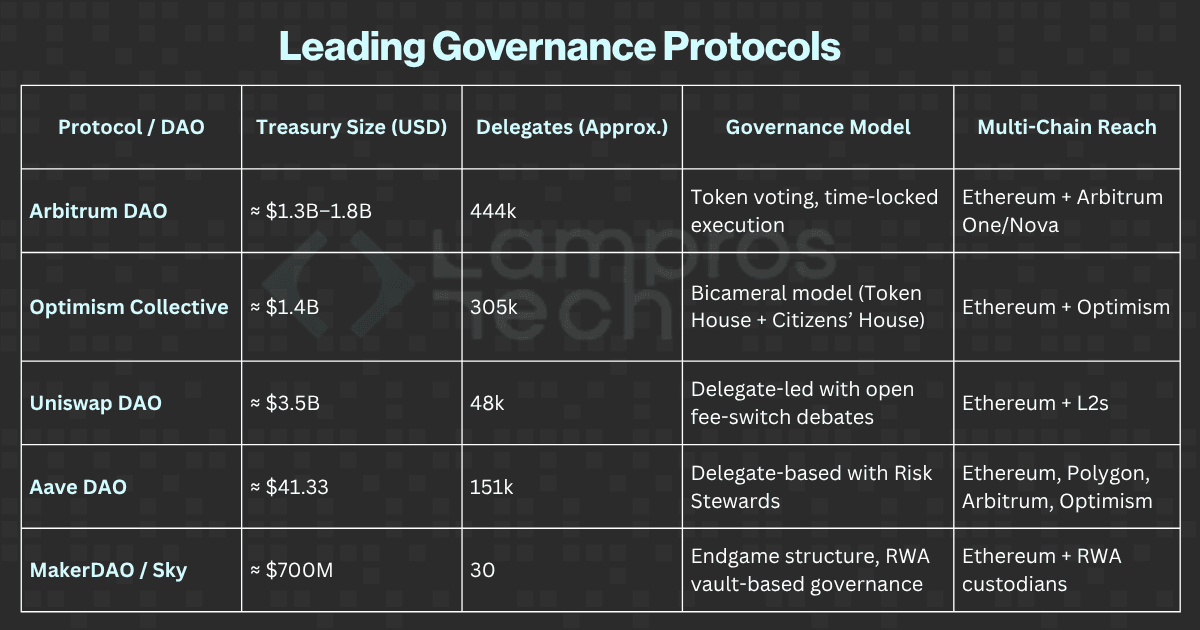
The snapshot shows that treasury size alone does not equal resilience. What matters is how protocols combine participation, accountability, and verifiable execution.
Numbers give us a snapshot, but not the full story.
To see how these governance protocols actually operate where they excel, where they fall short, and what that means for DAOs, builders, investors, and contributors, we now break them down by category.
While the snapshot gives us directional signals, it doesn’t capture the full story.
To understand how these governance protocols actually operate where they excel, where they fall short, and what that means for DAOs, builders, and investors, we now turn to detailed deep dives.
Not every governance protocol serves the same purpose, and comparing them side by side without context can be misleading.
To bring clarity, we’ve grouped them into four functional categories that reflect how DAOs actually operate in 2025:
Each category represents a different layer of Web3 governance, from institutional asset management to experimental legitimacy models.
Numbers show direction, but governance is about how protocols handle power, participation, and execution.
Below, we evaluate leading governance systems against the five dimensions: decentralisation, participation, efficiency, transparency, and security.
To move beyond surface metrics, we break governance protocols into categories that reveal how they truly function in practice.
Treasuries are no longer just savings accounts they are active capital allocators.
This category highlights DAOs like MakerDAO and Compound, which define how governance systems manage assets at scale.
We will see how these protocols balance decentralisation, participation, efficiency, transparency, and security when billions are at stake.
MakerDAO (rebranded Sky) has grown beyond stablecoin issuance into one of the largest allocators of real-world assets (RWAs).
Its treasury strategy, especially through U.S. Treasuries, positions it as the closest DAO equivalent to an institutional asset manager.
Compound remains focused on lending markets, maintaining a narrow governance model centered on parameter updates rather than diversification into RWAs. It prioritizes simplicity, efficiency, and predictable execution cycles.
Tools are the rails that turn votes into outcomes. Without them, DAO decisions risk remaining symbolic.
This section highlights protocols like Uniswap and Aave, which drive decentralized governance with real-world impact through streamlined voting and execution.
Delegates make governance scalable but risk power capture.
With the largest treasury in DeFi (~USD 3.5B), Uniswap DAO shows the power of scale. However, drawn-out debates like the fee switch reveal governance latency risks, even with strong delegate ecosystems.
Aave’s DAO treasury (~41.33 USD) spans Ethereum, Polygon, Arbitrum, and Optimism. Its governance model relies on delegates and risk stewards to dynamically manage multi-chain lending and liquidity risks.
Delegates are now the backbone of many large DAOs. They make governance scalable but also concentrate power.
Here, we examine how Uniswap and Aave balance efficiency, legitimacy, and risk in systems heavily reliant on professional delegates.
Protocols here test legitimacy beyond token voting.
Optimism’s governance uniquely balances power through a bicameral system: the Token House, where voting power is based on OP token holdings, and the Citizens’ House, a democratic chamber granting one vote per verified participant.
This dual model combines token-weighted influence with identity-based participation to ensure more inclusive, accountable decision-making.
It protects against governance capture and drives sustainable growth for the Optimism Superchain ecosystem, marking an innovative evolution in decentralized governance.
Its RetroPGF program allocates millions in OP tokens to public goods, making it a live experiment in balancing economic power with legitimacy.
Arbitrum DAO oversees one of the largest treasuries in Web3 (≈ USD 1.3 - 1.8B, DeepDAO).
Its token-voting governance and timelocked execution shape billion-dollar grant programs like STEP, turning governance into a growth engine for its L2 ecosystem.
Starknet launched in 2025, Starknet combines token-holder voting with a technical council for oversight.
This hybrid model is designed to manage agility in a highly complex, zk-based ecosystem while safeguarding legitimacy.
NounsDAO uses daily NFT auctions to continuously onboard members, where 1 Noun equals 1 vote.
It's fully on-chain treasury and cultural brand-building show how identity and community can drive sustainable governance beyond financial incentives.
The snapshot and deep dives make one thing clear: governance in 2025 is no longer experimental but infrastructure.
Treasury scale alone does not guarantee resilience.
The protocols setting the standard in 2025 are those combining participation, accountable delegates, and verifiable execution. Others risk stagnation or worse, governance becoming a liability.
The snapshot and deep dives make one thing clear: governance in 2025 is no longer experimental but infrastructure.
The real question is how these systems will evolve under the pressures of AI, regulation, and cross-chain coordination.
In 2025, governance is no longer a symbolic process running in the background.
In 2025, governance has become the vital coordination layer of Web3, powering billions in DAO treasuries, guiding protocol upgrades, and sustaining legitimacy across diverse ecosystems.
The landscape is evolving with innovative governance models that balance institutional allocation, delegate expertise, and broader community legitimacy, signaling a new era where decisions shape the future of decentralized networks.
The analysis shows clear signals:
Yet the challenges remain unresolved. Participation rarely exceeds 15%, treasury diversification is uneven, and delegate capture risks persist.
Treasury scale, without accountability and verifiable execution, is not resilience; it is fragility waiting to surface.
Looking ahead to 2026-27, DAOs are changing the future of organisations through -
For builders, DAOs, and investors, the lesson is clear: governance is not an afterthought; it is a design choice that shapes protocol durability, adoption, and legitimacy.
Protocols that treat governance as programmable, verifiable infrastructure will set the standard. Those that continue to rely on symbolic or fragile systems will stagnate, or worse, become liabilities for the ecosystems they seek to govern.
Ultimately, governance serves as the coordination layer for Web3. It decides not just who votes, but who allocates, who executes, and who holds accountability in a decentralized world. The protocols that get this right will not just survive the next cycle, they will define it.
At Lampros Tech, we help DAOs move past symbolic voting and design governance that actually works, resilient treasuries, broader participation, and verifiable execution.
Explore our DAO services to see how we build systems that last.

Governance protocols are the systems that manage how decentralized organizations (DAOs) make decisions, allocate funds, and implement changes. In 2025, they are the backbone of Web3 coordination, influencing billions in assets and the future of decentralized networks.
Many DAOs struggle with engagement due to complexity, limited incentives, or lack of awareness. Low participation creates risks around legitimacy and concentration of power, making it a top challenge for DAO sustainability and fairness.
Models range from token-weighted voting to hybrid systems combining reputation or identity-based elements. Each affects inclusivity, efficiency, and risk differently, with newer designs aiming to balance power and foster broader participation.
Large treasuries concentrated in native tokens pose liquidity and governance capture risks. Cross-chain coordination and security vulnerabilities can also threaten execution of decisions, requiring robust safeguards like timelocks and multi-signature controls.
Future governance will likely involve AI agents to boost participation, cross-chain standards to manage complexity, and regulatory-friendly frameworks to onboard institutions. Protocols that innovate on transparency, accountability, and execution will lead Web3’s growth.
Need DAO guidance?
Prepare for audits, DAO upgrades, and multi-chain builds without hiring delays.
Let’s Talk