
COO @ Quorivex Systems
We wanted to automate a few workflows but weren't sure where to start. Lampros helped us cut through the noise and get something useful into production quickly.

CTO @ Teralynx Systems
They picked up our processes surprisingly fast and built around how we already worked instead of forcing us into a new system.

Financial Technology Company
We saw value pretty quickly. A lot of repetitive work that used to take hours every week simply stopped being a problem. Our team could focus on higher-value work instead.
Contact Us
Ready to Ship AI Systems to
Let's align architecture, execution, and delivery from day one.
Published On Nov 05, 2025
Updated On Nov 05, 2025
Web3 ecosystem grants are redefining how innovation is financed, building what venture capital can’t.
Instead of chasing profit, they sustain the public goods, developer tooling, and open infrastructure that keep decentralized networks alive.
In ecosystems like Arbitrum and Optimism, grants have evolved into a governance mechanism, like how DAOs direct collective capital toward transparency, resilience, and long-term impact.
What was once seen as community generosity is now a strategic funding model.
Arbitrum DAO, Optimism Collective, Polygon Labs, and the Solana Foundation collectively manage hundreds of millions in milestone-based, on-chain funding, proving that decentralized grants can rival the discipline of venture finance.
For founders and teams, these grants go beyond capital. They validate credibility, create alignment with ecosystem goals, and open doors to deep network integration.
In this guide, we’ll break down how Web3 startups can secure ecosystem grants from finding the right programs and crafting proposals to scaling beyond initial funding.
Let’s dive in.
By 2025, ecosystem-led funding has become the foundation of Web3 innovation.
According to DappRadar’s Web3 Grants Overview, over 50 active programmes now fund builders, infrastructure, and open-source development across major networks.
Earlier grants relied on broad incentives with limited tracking. The new wave is structured, data-backed, and focused on measurable outcomes with clear accountability.
This evolution signals a maturing approach where grants function as strategic investments in ecosystem growth rather than one-off funding events.
To understand how this shift plays out in practice, it’s worth examining the ecosystems pioneering these models and setting the benchmarks for builder-focused funding.
As these leading ecosystems refine their funding models, new priorities are beginning to take shape.
The focus now is shifting from broad developer support to specialized, high-impact domains that strengthen network resilience and decentralization.
According to Onchain.org’s 2025 analysis, ecosystem grants are now expanding into:
These evolving priorities reflect a broader shift in how ecosystems view grant capital not just as a catalyst for innovation, but as a framework for accountability and measurable progress.
This marks the beginning of a new funding reality, where grant programmes operate with the same rigor and outcome orientation once reserved for venture investment.
And understanding how grants and equity funding work is key to strategic decision-making for founders.
Grant frameworks are evolving. The Grant Maturity Framework (ArXiv, 2025) highlights a clear shift toward multi-phase, milestone-based funding with post-delivery evaluation.
DAOs now track progress via on-chain reporting and GitHub-linked dashboards, improving accountability and reducing grant inefficiency.
For founders, the opportunity is clear: ecosystems are still funding innovation aggressively but only for teams that can prove alignment, technical credibility, and measurable outcomes.
The 2025 landscape favors fewer but stronger teams that execute, deliver, and align deeply with ecosystem goals.
Yet many promising startups still stumble before crossing that line, not because of weak ideas, but because they fail to communicate value, readiness, or alignment effectively.
And recognizing these gaps is only the first step. What defines success is how teams navigate them, which brings us to the strategies that consistently deliver results.
Today, grant reviewers don’t fund potential; they fund readiness.
And the teams that stand out are those that align early, execute visibly, and engage consistently with their ecosystems.
With most top programs funding less than 20% of applicants, how you apply, structure, and communicate matters as much as what you’re building.
Here’s how winning teams turn alignment into credibility, and credibility into long-term trust.
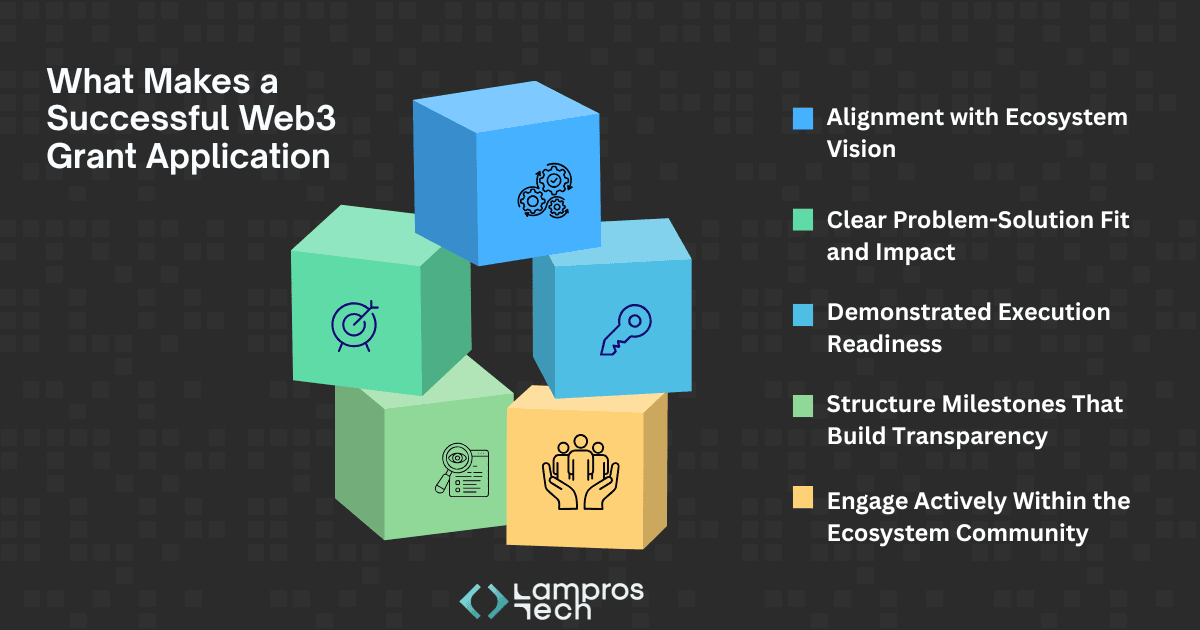
Every ecosystem funds through its own lens, understanding that context is your first strategic advantage.
Start by mapping your project’s goals to each network’s mission. Study past recipients, forum discussions, and milestone reports.
When reviewers see you’ve built for the network, not just on it, your proposal signals alignment, not opportunism.
In the 2025 funding environment, execution is communication. Foundations back builders who’ve already shown proof of traction and technical credibility.
Preparation builds credibility, but visible proof builds conviction.
Ecosystems today expect milestone-based, verifiable roadmaps that align funding with measurable outcomes.
Milestone-driven proposals signal operational discipline, and reviewers trust teams who think in results, not rhetoric.
Transparency is credibility. The most trusted teams make it easy to see how every resource creates ecosystem value.
In DAO ecosystems, on-chain transparency is more than compliance; it’s a trust signal.
Ecosystem reviewers pay attention to founders who are visible before they apply.
During programs like Arbitrum’s Questbook rounds, teams that stayed active and responded to feedback within 48 hours advanced significantly faster.
Community engagement transforms your proposal from a funding request into a contribution to the ecosystem narrative.
Your proposal should tell a complete story succinctly.
Data-driven storytelling converts ambition into trust. Simplicity shows mastery.
Execution is where preparation turns into proof.
Progress communicated transparently often leads to follow-on funding or direct protocol collaborations.
In Web3, credibility compounds like capital.
Every delivered milestone, audit report, and transparent update becomes social proof, a visible ledger of execution that investors and ecosystems trust.
Leverage each completed grant as a case study to highlight results in dashboards, pitch decks, and governance reports.
Projects that communicate transparently often secure follow-on funding, ecosystem partnerships, and investor interest.
Reputation is a multiplier, as the more consistently you deliver, the more doors open.
Ecosystem grants aren’t designed to sustain projects indefinitely; they’re meant to catalyse independence.
Define how your project sustains itself post-grant:
Sustainability proves you’re not just building within an ecosystem, you’re also helping it evolve.
Timing is often underrated but decisive.
Timing signals maturity and shows you understand when the ecosystem actually needs what you’ve built.
When you align deeply, execute transparently, and engage authentically, you’re not just competing for grants; you’re positioning your team as a long-term ecosystem partner.
Because in Web3, the most valuable capital isn’t funding, it’s credibility.
Ecosystem grants are no longer experiments; they’re the backbone of how innovation and alignment are funded in Web3.
In 2025, they define not only who builds, but how ecosystems grow and sustain credibility over time.
Founders today don’t view grants as one-off funding rounds. They see them as collaborative mechanisms for alignment opportunities to demonstrate execution, build trust, and contribute to the networks they help expand.
Ecosystems now are rewarding builders who deliver verifiable outcomes, maintain transparency, and keep contributing beyond the grant.
Because in Web3, credibility is the new capital, and ecosystem grants are the most effective way to earn it.
At Lampros Tech, we don’t just help you apply for grants; we help you build a winning motion.
Our Grants Motion Support service guides teams through every stage. Whether you’re applying for your first grant or scaling across multiple ecosystems, we help you build credibility that compounds with every milestone delivered.

Web3 ecosystem grants are funding programs by DAOs and blockchain foundations that support public goods, open-source projects, and infrastructure development. Unlike venture capital, they focus on impact, transparency, and ecosystem growth.
Startups qualify by demonstrating ecosystem alignment, technical readiness, and measurable outcomes. Most ecosystems like Arbitrum or Optimism fund teams that show execution through testnets, open-source code, or community engagement.
Leading ecosystems with active grant programs include Arbitrum DAO, Optimism Collective, Polygon Labs, Solana Foundation, and the Web3 Foundation. Each focuses on different priorities such as scalability, public goods, or zk-based infrastructure.
A strong proposal includes a clear problem-solution fit, milestone-based roadmap, transparent budgeting, and quantifiable impact. Ecosystems favor proposals that align deeply with their mission and prove accountability through on-chain reporting.
Ecosystem grants build credibility, foster community trust, and create deep integration with networks. Many successful startups use grants as a launchpad to attract investors, partnerships, and follow-on ecosystem funding.
Grant Support
End-to-end support across discovery, proposals, milestones, and transparent reporting.
Let’s Talk