
COO @ Quorivex Systems
We wanted to automate a few workflows but weren't sure where to start. Lampros helped us cut through the noise and get something useful into production quickly.

CTO @ Teralynx Systems
They picked up our processes surprisingly fast and built around how we already worked instead of forcing us into a new system.

Financial Technology Company
We saw value pretty quickly. A lot of repetitive work that used to take hours every week simply stopped being a problem. Our team could focus on higher-value work instead.
Contact Us
Ready to Ship AI Systems to
Let's align architecture, execution, and delivery from day one.
Published On Oct 30, 2025
Updated On Oct 30, 2025
In Web3, how you raise is just as important as what you build.
Capital today is no longer neutral; it’s a governance architecture. It determines who holds influence, how ownership evolves, and what incentives shape your protocol’s long-term trajectory.
By 2025, funding in Web3 has matured beyond speculative cycles. Builders now navigate two distinct and deliberate paths:
These are not merely financial instruments; they represent two philosophies of growth.
Grants strengthen decentralization and public-good development; investments accelerate market penetration and liquidity.
Your funding model now defines more than your treasury; it defines your governance.
Whether you optimize for ecosystem alignment or market expansion, the capital you choose encodes the social, technical, and economic DNA of your protocol.
This blog explores both sides of that equation: what Web3 grants really represent, how investments differ, and how to align your funding path with your mission, stage, and community.
Let’s get started.
A Web3 grant is non-dilutive capital distributed by DAOs, foundations, or Layer-2 ecosystems to fund builders who strengthen the network’s infrastructure and long-term utility.
Unlike venture capital, grants don’t require equity or tokens; they reward measurable, open-source contributions that expand the ecosystem’s value.
In Web3, grants serve as alignment tools, not donations: they channel capital toward projects that advance shared goals like scalability, composability, and decentralization.
Ecosystem treasuries increasingly treat grants as part of their governance and growth design.
Networks such as Arbitrum, Optimism, Base, and Starknet have institutionalised grant programs not as marketing tools but as strategic levers for ecosystem health, like funding, reusable infrastructure, cross-chain integrations, and long-term developer retention.
These programs exist for a reason that strengthens their ecosystems through purposeful and measurable impact.
Ecosystem grant programs are not random acts of funding; they’re structured mechanisms designed to turn capital into long-term network effects.
Here’s how leading ecosystems design and deploy them to maximise impact to:
In essence, ecosystem grants turn funding into function, like transforming capital into aligned, measurable progress that compounds over time.
Today, modern grant programs operate differently, which ensures every allocation contributes to sustainable ecosystem growth.
Modern Web3 grant programs have evolved from discretionary funding into structured, transparent capital frameworks designed to drive measurable impact.
Frameworks such as Optimism’s Retro Funding and Arbitrum’s LTIPP have set new accountability standards, combining KPI-linked reporting and public dashboards to ensure transparent, merit-based distribution.
When designed well, grant systems create positive feedback loops where:
Builders deliver, the network gains functionality, and as the network grows, new grants can fund even deeper layers of infrastructure.
Grants aren’t just funding; they are the governance layer of ecosystem growth, empowering builders to create lasting value without giving up control.
Here’s why that matters for every network aiming to scale responsibly.
Web3 Grants matters because they are more than funding tools; they’re coordination mechanisms that align governance, growth, and trust across ecosystems.
Their impact can be understood across a few core dimensions, which are:
In essence, grants turn capital into alignment, enabling ecosystems to grow collectively, transparently, and sustainably.
To complete the funding picture, it’s equally important to understand how Web3 investments operate, the structured, growth-oriented capital models that shape scalability and governance across protocols.
A Web3 investment is dilutive capital equity, tokens, or hybrid instruments provided by venture funds, institutional partners, or ecosystem investment arms to scale protocols that have proven traction.
Unlike grants, which fund ecosystem alignment, investments fund acceleration by exchanging ownership for capital depth, liquidity, and strategic growth.
They enable builders to expand beyond validation, supporting sustained development, cross-chain expansion, and product-market maturity.
To understand their deeper purpose in the ecosystem, let’s look at why web3 investments exist.
As protocols mature, their priorities shift from validation to sustainability.
Scaling a decentralized network demands more than code; it requires structured capital for audits, liquidity, incentives, and real-world integrations.
Web3 investments fill this gap, addressing four key needs that drive long-term growth:
Funds like Base Ecosystem Fund, Starknet Ventures, and Coinbase Ventures exemplify this discipline, focusing on builders who can deliver recurring utility rather than speculative yield.
Understanding this new investment discipline starts with how modern Web3 funding structures actually work.
Modern Web3 investments have matured from speculative token rounds into structured, performance-based capital models that emphasize accountability and long-term alignment.
This evolution is reflected across a few core areas that are:
Projects like EigenLayer, Celestia, and zkSync follow this path, combining early ecosystem validation with institutional funding for scaling.
This shift marks the maturity of Web3 capital, where execution now outweighs speculation.
In Web3, a well-designed funding brings depth, alignment, and accountability, turning growth into long-term sustainability.
Its impact becomes clear across a few key areas that define how investments drive lasting protocol success, which are:
Investments provide the long-term financial depth needed for product scaling, operational maturity, and cross-chain expansion, turning early traction into sustainable business momentum.
Beyond capital, investors offer ecosystem access, exchange listings, partnerships, and market expertise that accelerate protocol adoption and strengthen liquidity presence.
Investor-backed structures introduce measurable milestones, audit readiness, and reporting standards, fostering responsible treasury management and long-term trust in protocol governance.
Today, investments have matured from hype-driven bets to structured partnerships that demand clarity, credibility, and long-term design thinking.
Both grants and investments carry unique strengths and trade-offs. Each encodes different incentives around ownership, governance, and long-term alignment.
Let’s break them down.
Every protocol eventually faces a defining question, not just how to raise capital, but what kind of capital to align with.
In Web3, both grants and investments shape a protocol’s incentives, ownership, and governance in fundamentally different ways.
Grants align your mission with the ecosystem’s shared goals, rewarding open-source contribution and decentralization.
Investments accelerate market presence and liquidity, but with oversight and ownership trade-offs.
The real challenge isn’t choosing one; it is understanding what you’re optimizing for: alignment, autonomy, or acceleration.
This is where trade-offs emerge, not as binaries, but as design choices defined by how you balance ownership, control, runway, and long-term mission alignment.
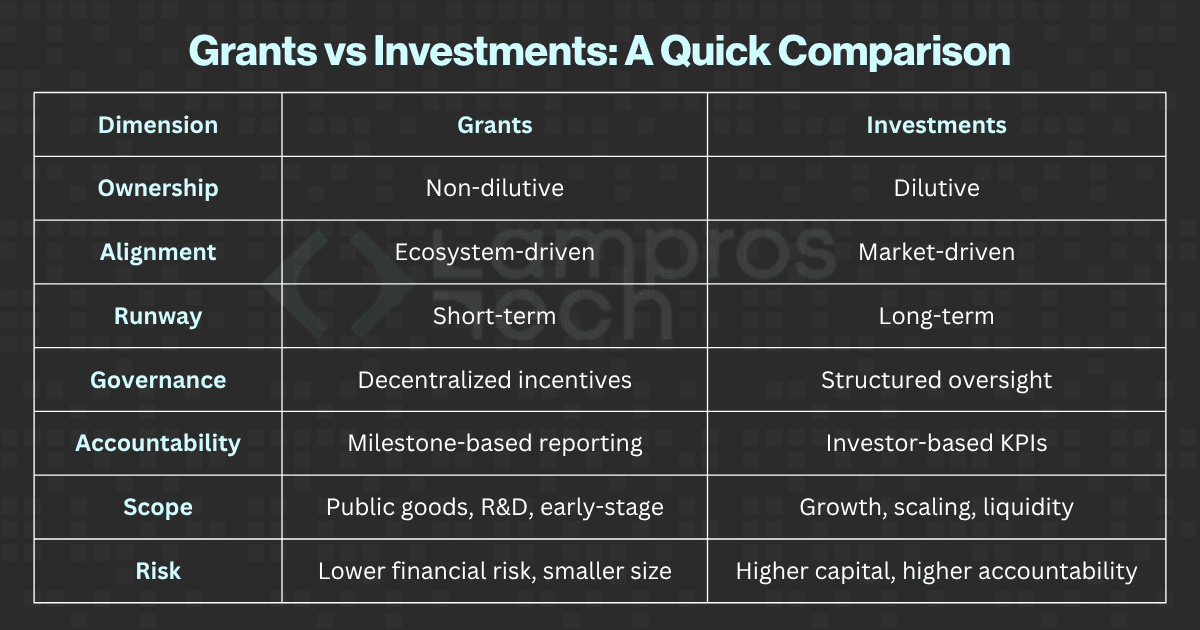
Grants provide alignment without dilution. They help builders earn community trust and validate ideas transparently through measurable milestones.
Investments provide scale with structure. They enable protocols to operationalize and expand, but introduce ownership trade-offs and governance complexity.
The real challenge for founders isn’t choosing one; it’s understanding what their current stage demands.
Early protocols benefit from credibility and alignment; maturing projects need structure and capital depth.
In Web3, the funding model you choose determines how power flows, how trust compounds, and how your ecosystem evolves.The strongest teams design capital as deliberately as they design code with clarity, accountability, and purpose.
Designing capital intentionally is the first step. The next step is choosing which model type to choose between grant, investment, or hybrid for your protocol’s maturity and mission.
Choosing between grants, investments, or a hybrid model depends on your stage, goals, and governance design.
The most resilient teams treat capital selection as a staged progression, not a one-time event, each stage demanding a different balance of alignment, control, and capital depth.
Let’s look at how this progression typically unfolds across different stages of a protocol’s growth.
In the prototype or pre-launch phase, ecosystem grants are your most strategic starting point. At this stage, credibility and alignment matter more than liquidity.
DAO or L2 grants help teams:
Grant capital also acts as social proof, a public endorsement from the ecosystem that validates your contribution’s relevance and quality. It’s the trust layer every protocol needs before seeking external investors.
Once you have measurable traction with users, integrations, or on-chain metrics, investment capital becomes the next logical step.
This stage demands deeper runway, liquidity provisioning, and operational scale that grant funding alone can’t support.
Investments enable teams to:
But capital brings accountability. Choose investors who share your governance philosophy, not just your valuation expectations.
In 2025, most leading protocols combine grants for validation with investments for scaling sequencing capital strategically for compounding impact.
The optimal scaling sequence looks like this:
Protocols like Optimism and Starknet exemplify this hybrid approach, validating early through grants, then expanding with selective private capital.
This model reinforces two principles:
With these principles in mind, founders should reflect on a few key questions before raising capital:
These questions aren’t operational; they’re architectural.
They define not just how you raise, but how your protocol grows, governs, and sustains itself over time.
Even well-structured funding paths can fail when capital is mistimed or misaligned.
Here are the common mistakes that can be avoided to keep funding aligned with long-term success.
Even experienced decision makers stumble when translating ambition into capital architecture, where every funding decision interacts with governance, liquidity, and trust.
Most mistakes don’t come from poor ideas; they stem from misaligned timing, incentives, or governance design.
Here are the most frequent pitfalls which has been observed and how disciplined builders avoid them.
Avoid this by:
Avoid this by:
Avoid this by:
Avoid this by:
Avoid this by:
Designing intentionally is the hallmark of maturity. In the end, sustainable protocols don’t just raise capital, they architect it.
In the end, funding discipline is as critical as technical design.
Avoiding these pitfalls isn’t just about managing money; it’s about preserving governance integrity, trust, and long-term resilience.
The most mature teams don’t react to capital; they architect it with purpose, ensuring every decision strengthens both their protocol and the ecosystem it serves.
Every grant, investment, or hybrid round shapes how decisions are made, how power flows, and how your ecosystem sustains itself over time.
The strongest protocols in 2025 treat funding the way they treat architecture:
When capital mirrors these same principles, it becomes more than fuel; it becomes a foundation.
Grants build credibility and community trust while investments build scale and operational endurance.
At Lampros Tech, we provide complete grant and funding support from discovery to delivery, built on transparency, accountability, and measurable impact.
If you’re building for alignment, resilience, and measurable impact, explore our web3 grant support to structure capital that strengthens your mission, not just your treasury.

Web3 grants are non-dilutive ecosystem funding designed to support open-source development, while investments are dilutive capital exchanges that provide financial depth and scalability for protocols with proven traction.
Grants fund public goods, developer tooling, and infrastructure, reinforcing decentralization and transparency while aligning projects with ecosystem goals.
Early-stage teams should use grants for validation and community alignment; once traction and measurable impact are proven, investments help scale operations and liquidity.
Grants maintain autonomy and ecosystem credibility but offer limited capital; investments provide runway and market reach but introduce governance and ownership trade-offs.
Yes. Hybrid funding is an increasingly common protocols that validate through grants first and later attract strategic investors for scaling, balancing autonomy with growth.
Grant Support
End-to-end support across discovery, proposals, milestones, and transparent reporting.
Let’s Talk