
COO @ Quorivex Systems
We wanted to automate a few workflows but weren't sure where to start. Lampros helped us cut through the noise and get something useful into production quickly.

CTO @ Teralynx Systems
They picked up our processes surprisingly fast and built around how we already worked instead of forcing us into a new system.

Financial Technology Company
We saw value pretty quickly. A lot of repetitive work that used to take hours every week simply stopped being a problem. Our team could focus on higher-value work instead.
Contact Us
Ready to Ship AI Systems to
Let's align architecture, execution, and delivery from day one.
Published On Dec 02, 2025
Updated On Feb 16, 2026

Web3 grants are evolving, and the numbers are showing it.
In Q1 2025 alone, the Ethereum Foundation (EF) disbursed $32.65 million across more than 90 projects under its Ecosystem Support Program.
Now, programs from Arbitrum DAO, Optimism Collective, and other ecosystem-level grant funds have shifted toward milestone-based models, where funding is released only after measurable progress is verified.
Every milestone, update, and metric can determine whether you move to the next step or get filtered out.
This guide digs into that shift, how milestone-based funding works in 2026, what ecosystems really look for, and how founders/builders can structure proposals so they survive scrutiny and unlock capital.
Let’s dive in.
Milestone-based funding is how DAOs now keep funding accountable. Instead of full upfront payouts, teams receive funds in stages, each unlocked only after verifiable progress.
For teams, funding is no longer a one-time approval. It’s a continuous process where every milestone must earn its release.
This model protects DAO treasuries, increases transparency, and rewards consistent execution.
Web3 programs now use several variations depending on how progress is tracked and verified:
Most milestone-based programs follow a clear sequence of:
Proposal & Milestone Definition → Verification → Disbursement.
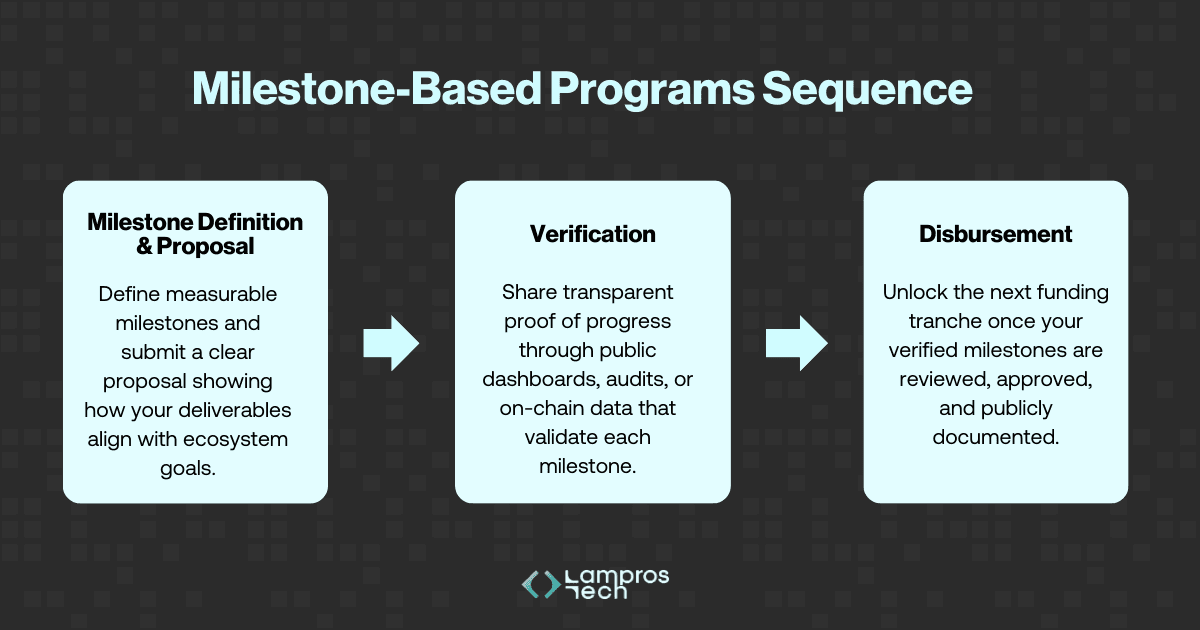
These milestones are mapped directly in the Arbitrum DDA 3.0 in their Rubrics - New Protocols and Ideas which mentions to ecosystem KPIs like TVL growth, transaction volume, cross-protocol integrations, or unique active users.
Once a milestone is submitted, reviewers validate results through on-chain activity, open dashboards, or product usage data.
Many DAOs now require publicly auditable verification, reducing subjectivity and making progress visible to the community.
If the milestones meet expectations, then the next round of funding is released. If they don’t, payments are paused or withheld.
Once your structure is solid, the next step is knowing what to measure and how to design milestones that strengthen your chances of getting funded.
Before you start writing your milestones, it’s important to know where your project currently stands.
Every product sits at a different stage; some are just starting, others are testing, and a few are already live.
Here are three common stages where a project can be, and how you can structure milestones for each one:
When you begin defining your milestones, there are several factors to keep in mind. Each milestone should be tailored to your product’s stage, goals, and overall vision.
Below are example frameworks you can adapt to your own project and use as a guide while designing your milestones.
If you’re starting from zero, your early milestones should focus on making your idea tangible.
This stage is about turning concepts into code and proving that the foundation works before any users ever touch it.
At this stage, you’re not launching a product yet; you’re building its foundation. Set up your core architecture, deploy initial smart contracts on testnet, and connect backend systems with a working CI pipeline.
You should look for KPIs like -
You can verify progress through -
This step is about proving your idea works in a real environment, creating a solid base for everything that follows.
At this stage the goal is to launch your MVP on a testnet, validate that core flows work end-to-end, and collect feedback from early testers or developers.
You can realistically do this by deploying the working frontend (even a basic one), integrating one partner protocol or API, and enabling users to interact with smart contracts through real transactions on testnet.
You should look for KPIs like-
You can verify this through -
This step demonstrates that your concept is functional, tested, and gaining early traction before mainnet deployment.
Here, the focus shifts from building to validating. You’ll conduct smart contract audits, fix critical issues, and improve performance before the mainnet release.
In real-world terms, this means running internal QA tests, engaging an external audit team, and optimizing gas usage through benchmark comparisons.
You should look for KPIs like-
You can verify this through -
This step ensures your product is secure, stable, and ready for public use.
This is where your project goes live. Deploy the verified version to mainnet, enable user access, and ensure integrations run smoothly.
Realistically, this includes setting up production RPCs, running initial transactions, monitoring contract performance, and verifying deployment through explorers.
You should look for KPIs like -
You can verify this through mainnet contract links, public dashboards like Dune or Flipside, and audit partner confirmations. This milestone proves you’ve moved from testing to delivering real value on-chain.
Once live, your focus turns to scaling adoption and building visibility. Run targeted marketing campaigns, launch community initiatives, and form partnerships with ecosystem players.
In practice, this could mean incentivized campaigns, collaborations with DAOs, or integrations with other Arbitrum protocols.
You should look for KPIs like -
You can verify this through -
This phase shows that your product is not only live but also growing with measurable community traction.
If you already have a functional product running on testnet, this phase is about making it mainnet-ready. The goal is to optimize performance, complete audits, deploy securely, and then drive user adoption.
At this stage, your product is live on testnet, but not yet refined for production. Focus on improving gas efficiency, fixing performance issues, and preparing for audits.
This typically includes running benchmark tests, simulating real-world usage, monitoring contract execution, and setting up alert systems.
You should look for KPIs like -
You can verify this through -
This step ensures your testnet build performs well under realistic conditions and is audit-ready.
Once testnet performance is stable, move to a full security audit. Engage external auditors, review code internally, and patch all vulnerabilities.
In real practice, teams collaborate with firms like Code4rena, Hacken, or independent auditors to validate contract integrity.
You should look for KPIs -
You can verify this through -
This step ensures technical assurance and builds reviewer confidence before mainnet deployment.
Now you transition from validation to production. Deploy the verified build on mainnet, complete explorer verification, and make your launch announcement.
This includes initializing production RPCs, monitoring contract execution, and confirming successful user transactions.
You should look for KPIs like -
You can verify this through -
This milestone marks your project’s entry into real-world usage.
With your mainnet live, focus on adoption and ecosystem expansion. Launch campaigns, partner with DAOs or protocols, and host workshops to onboard users and developers.
In real-world cases, this includes liquidity programs, developer tutorials, and collaborations with ecosystem projects.
You should look for KPIs like -
You can verify this through -
This phase transforms your project from a successful launch into a growing ecosystem participant.
If your product is already live on mainnet, your milestones should focus on reliability, growth, and long-term sustainability. The goal here is not just to stay live, but to scale efficiently, build trust, and create lasting impact within the ecosystem.
At this stage, the focus is on ensuring your mainnet deployment runs smoothly and reliably.
You’ll deploy on Arbitrum One or Nova, set up monitoring systems, and establish clear playbooks for handling incidents or downtime.
You should look for KPIs like -
You can verify this through -
This milestone builds operational trust and proves your product can perform under real user activity.
Once reliability is established, the next step is driving consistent growth and user retention. Launch co-marketing campaigns, ecosystem collaborations, and transparent reporting dashboards that track real usage and revenue metrics.
You should look for KPIs like -
You can verify this through -
This milestone shows that your product isn’t just live, it’s thriving and adding verifiable value to the ecosystem.
In this final phase, focus on sustainability and accountability. Deliver a detailed impact report, outline your next roadmap, and document how the project will sustain itself beyond grant funding.
You should look for KPIs -
You can verify this through -
This milestone proves that your project is not only successful today but prepared for long-term ecosystem contribution.
By the time your milestones reach the mainnet stage, your structure should tell a clear story of progress and proof.
But this is also where many projects stumble, not because their ideas are weak, but because their milestones lose clarity or evidence along the way. This is what is mentioned in the next section that where they fail.
Even capable teams lose momentum under milestone-based review. The common blockers are:
In most cases, the real issue is a lack of precision. Without measurable checkpoints, even strong ideas look uncertain.
That’s why many Ethereum and L2 grant proposals fail. Short, unclear structures and unverifiable milestones make it hard for reviewers to trust the plan.
Once your milestones are designed, the real challenge begins: executing them with precision, timing, and transparency that turn approval into lasting credibility.
Once milestones are approved, delivery becomes the real differentiator. Funding no longer depends on potential; it depends on how predictably and transparently you execute.
Top builders treat milestone execution like product operations, measured, documented, and paced for compounding trust.
Timing decides momentum. DAO reviewers operate in fixed cycles, usually monthly or quarterly, and missing one can delay payouts for weeks.
High-performing teams plan around those rhythms:
Projects that time submissions with DAO calendars consistently see faster approvals and fewer clarifications, especially in programs like Arbitrum and Optimism Mission Rounds.
Deliver early. Verify often. Make your progress visible before anyone asks.That visibility compounds into trust, and trust is the fastest currency in DAO funding.
Every serious team hits scope changes. What separates trusted builders from the rest is how they handle them.
A successful renegotiation feels like risk management, not damage control:
DAO review data from 2024 - 2026 shows that milestone renegotiations submitted before the due date achieved roughly 70 % approval, while post-deadline requests dropped below 40%. Timely communication isn’t bureaucracy, it’s insurance.
Milestone funding is not the finish line, it is the foundation for the next era of Web3 capital.
Ethereum’s grant ecosystem is moving toward programmable funding that verifies progress automatically and rewards execution in real time.
In 2026, hybrid models like milestone + retroactive funding, quadratic reward pools, and streaming contracts will define how grants flow continuously, transparently, and based on verifiable proof.
At Lampros Tech, we help teams turn grant proposals into verified milestones and milestones into measurable success.
Through our Grants Motion Support service, we guide builders from strategy to execution, helping them design clear proposals, define fundable milestones, and deliver outcomes that build lasting credibility across ecosystems.

Milestone-based funding breaks a grant into stages, where each payout is released only after measurable progress is verified.Unlike traditional one-time grants, this model rewards real execution funding moves when deliverables, on-chain activity, or KPIs prove that progress is genuine.
Verification usually happens through a mix of public dashboards, GitHub repositories, and on-chain data.Many programs like Arbitrum Questbook or Optimism Missions require open, auditable proof such as contract links, user metrics, or attestations before unlocking the next tranche.
The best KPIs are quantifiable and aligned with the product stage, for example: • Number of deployed contracts or test transactions (for early builds)
• Active users or transaction volume (for mainnet stages)
• Verified integrations or ecosystem collaborations (for growth milestones)
Reviewers look for signals that progress can be tracked and verified, not vague goals.
Most failures come from unclear structures, unverifiable progress, or overpromised KPIs.DAO reviewers need precision if milestones lack measurable checkpoints or transparent verification, even strong projects struggle to gain trust or funding continuity.
Lampros Tech supports founders across the full journey from crafting compelling proposals to structuring milestones, defining KPIs, and preparing verification assets.Through our Grants Motion Support service, we help teams secure DAO funding and deliver verifiable outcomes that build long-term credibility across ecosystems.
Grant Support
End-to-end support across discovery, proposals, milestones, and transparent reporting.
Let’s Talk