
COO @ Quorivex Systems
We wanted to automate a few workflows but weren't sure where to start. Lampros helped us cut through the noise and get something useful into production quickly.

CTO @ Teralynx Systems
They picked up our processes surprisingly fast and built around how we already worked instead of forcing us into a new system.

Financial Technology Company
We saw value pretty quickly. A lot of repetitive work that used to take hours every week simply stopped being a problem. Our team could focus on higher-value work instead.
Contact Us
Ready to Ship AI Systems to
Let's align architecture, execution, and delivery from day one.
Published On May 13, 2026
Updated On May 20, 2026
Your marketing team is busy. But being busy is not the same as being effective.
Leads go cold because follow-ups happen too late. Ad spend gets wasted on low-intent audiences. High-value prospects slip through because teams cannot react fast enough.
This is why AI marketing automation is becoming a priority for modern businesses.
Instead of relying on fixed workflows and manual decisions, companies are now using AI to optimize campaigns, personalize customer journeys, score leads, and automate marketing operations in real time.
According to Salesforce’s State of Marketing report, 84% of marketers already use AI in some form. Yet most businesses still only use it for surface-level tasks. The bigger opportunity lies in predictive lead scoring, AI-driven segmentation, dynamic ad targeting, and workflow optimization.
McKinsey reports that companies applying AI in marketing and sales have seen lead increases of more than 50% along with lower acquisition costs.
In this guide, we break down eight practical AI marketing automation use cases businesses are using to scale smarter in 2026.
Let’s get started.
AI marketing automation combines artificial intelligence with marketing automation tools to improve how businesses run campaigns, manage customer journeys, and optimize marketing workflows.
Unlike traditional automation, which follows fixed rules, AI-based marketing automation can analyze customer behavior, predict intent, personalize interactions, and optimize campaigns in real time. This helps businesses improve targeting, reduce manual work, and scale marketing operations more efficiently.
Today, companies are using AI across email marketing, lead scoring, customer segmentation, ad optimization, and sales workflows to drive better conversion rates and faster decision-making.
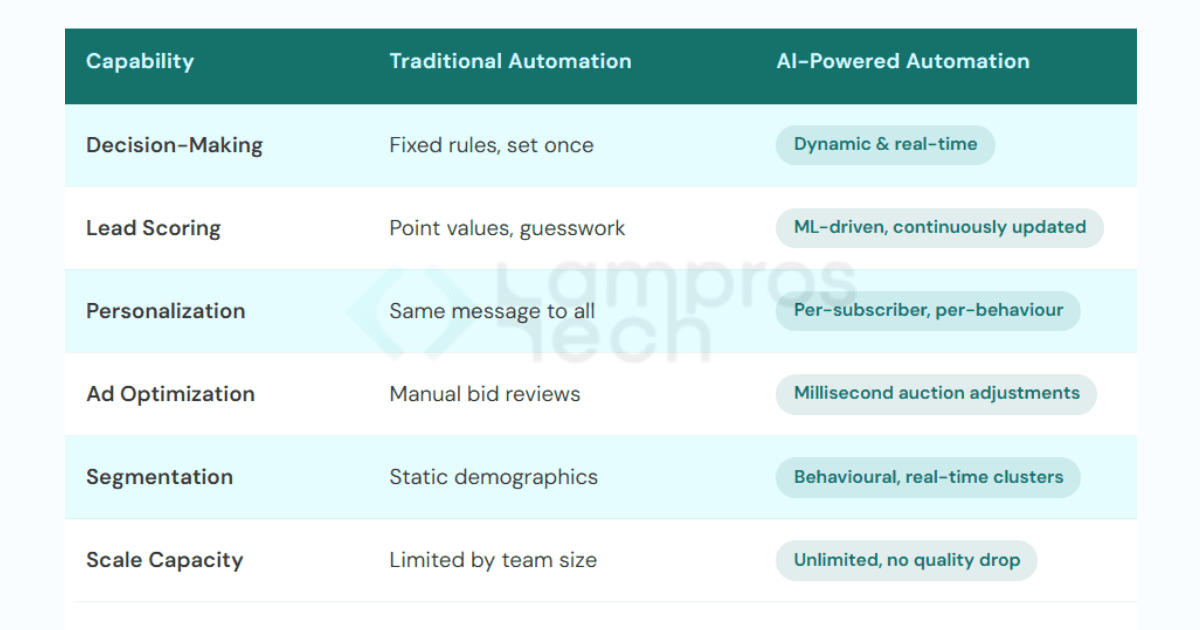
If you want to explore how AI is used in marketing automation, read our guide on AI workflow automation in marketing for modern businesses.
As AI marketing automation continues to evolve, businesses are moving beyond basic automation and applying AI across core marketing and sales workflows.
Below are some of the most practical AI marketing automation use cases companies are using to improve efficiency, increase conversions, and scale smarter in 2026.
Every use case below is being actively deployed by real businesses right now. Every result cited is sourced, specific, and traceable.
We have seen these same patterns play out across the businesses we work with, which is why we are not just telling you what AI can do. We are showing you what it actually delivers.
Most email campaigns treat every subscriber the same way, with the same subject line, same send time, same content block, regardless of where they are in the buying journey.
That approach does not just underperform. It trains your audience to ignore you.
According to Mailchimp's Email Benchmarks, the average email open rate across industries is just 21.5%.
The core reason is almost always the same: the message is not relevant enough to the person receiving it.
AI fixes this by continuously analysing each subscriber's individual behaviour and adapting automatically:
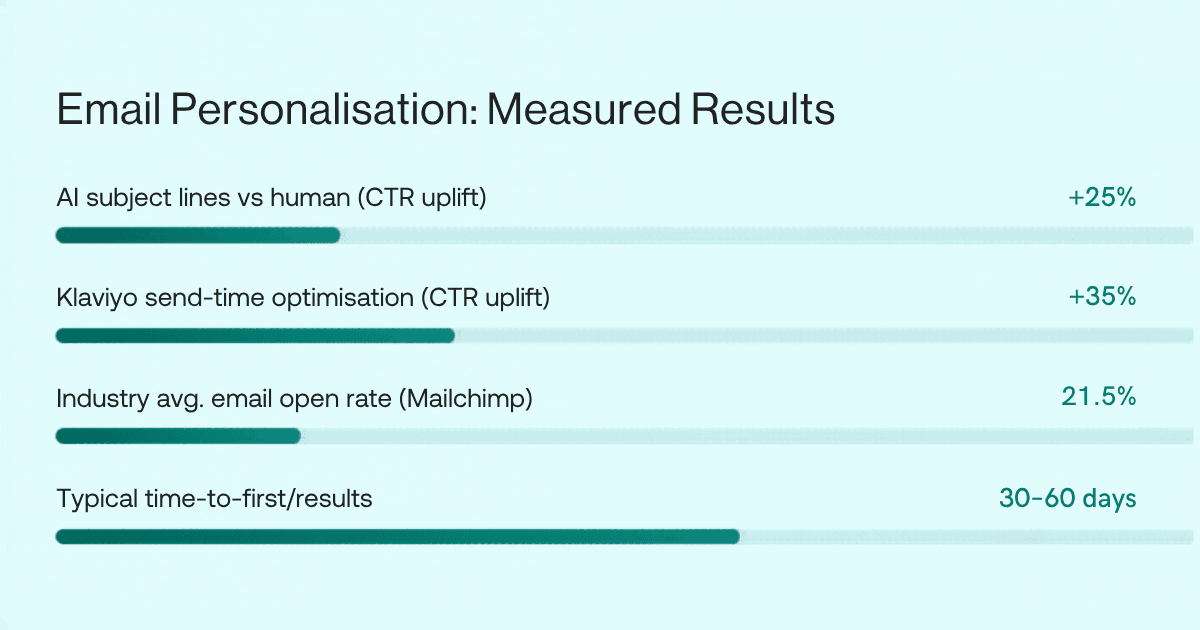
As per research, AI-generated subject lines outperformed human-written ones by 25% on click-through rates across 250+ enterprise campaigns.
Klaviyo's send-time optimisation has helped brands increase click-through rate by up to 35%.
Across the businesses, email personalisation is consistently the fastest use case to implement and the first to show results, typically within 30 to 60 days.
Where to start: Enable send-time optimisation inside HubSpot, Klaviyo, or ActiveCampaign. It requires no changes to your existing content or segments and delivers the fastest return of any starting point.
Without a reliable way to rank leads, sales reps default to the newest or loudest ones and are not the most likely to close. While high-intent prospects get ignored, and low-quality leads consume the entire pipeline review.
Whereas, traditional scoring assigns fixed point values like pricing page visit, 20 points; ebook download, 10 points.
The problem is that rules are set once, rarely updated, and built on guesswork rather than real conversion data.
Machine learning marketing automation works differently. The AI analyses thousands of signals simultaneously:
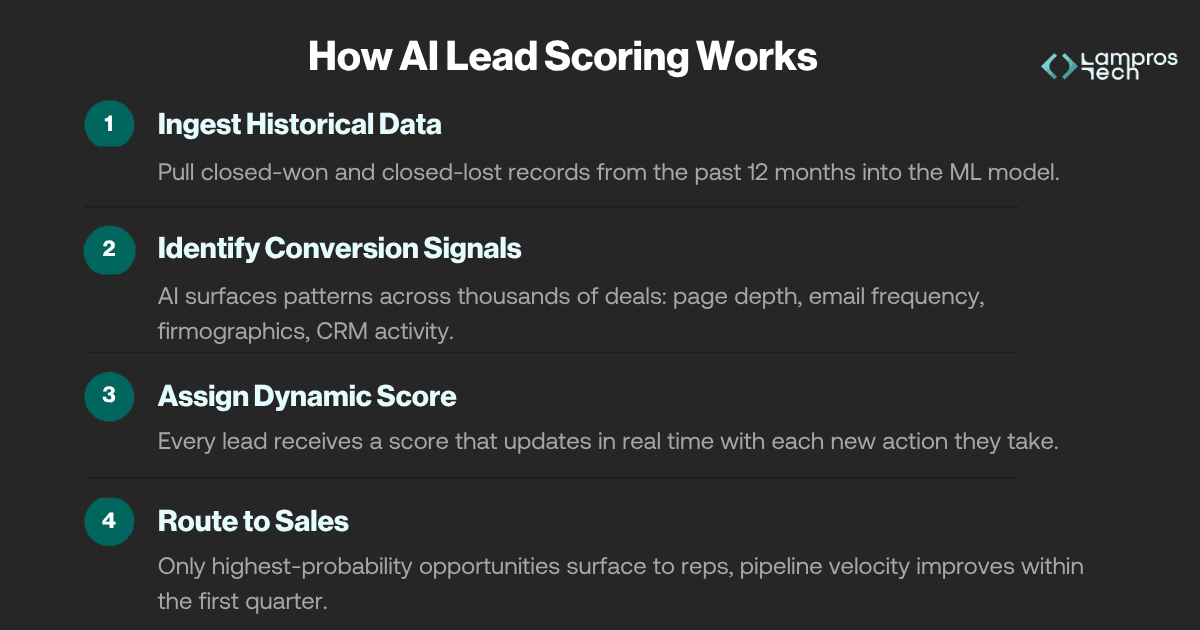
The result is a dynamic score that updates every time a prospect takes a new action, giving your sales team a continuously refreshed view of exactly where to focus today.
Salesforce Einstein identifies which leads are statistically closest to converting, surfacing patterns across thousands of historical deals that no human analyst could detect manually.
In our experience with B2B teams, the moment reps stop chasing cold leads and focus only on the highest-probability opportunities, pipeline velocity improves within the first quarter.
Where to start: Pull your closed-won and closed-lost data from the last 12 months. Most modern CRMs can run basic predictive scoring natively once that historical data is clean and structured.
A high-intent prospect lands on your pricing page at 10pm, asks a question, gets no response, and goes to a competitor.
That lead did not go cold because your product was wrong. It went cold because no one was there.
Harvard Business Review found that lead qualification rates drop by 400% when response time exceeds five minutes. For most teams, five minutes is optimistic during business hours, let alone overnight.
AI chatbots remove this constraint entirely. Modern conversational AI can:
The businesses which work with that deploy chatbots on high-traffic pages see the fastest ROI of any use case on this list, because the leads were already there. The AI just stops them from leaving.
Where to start: Deploy on your three highest-traffic pages first: pricing, demo request, and homepage. Train it to ask three qualification questions and route based on answers.
Content production bottlenecks cost marketing teams more than they realise. Briefs, drafts, ad copy variations, social captions, email sequences, the volume compounds and slows everything down.
AI content tools do not replace writers. They remove the parts of the process that should never have required a writer in the first place:
According to CoSchedule's 2025 State of AI in Marketing Report, 85% of marketers now use AI tools for content creation, with 83% reporting a direct increase in productivity and an average saving of more than five hours per week.
What we consistently see is that AI content tools have the biggest impact when introduced to fix one specific bottleneck, not deployed across the entire workflow at once. Start narrow. Prove the speed gain. Then expand.
Where to start: Apply AI to your highest-volume, lowest-complexity tasks first, meta descriptions, subject line variations, ad copy, and social captions. Fastest efficiency gains, lowest quality risk.
Most brands post when it is convenient for the team, not when their audience is actually online. A well-written post at the wrong time quietly disappears.
That is not a content problem. It is a timing problem.
AI-powered social tools analyse your historical engagement data and surface:
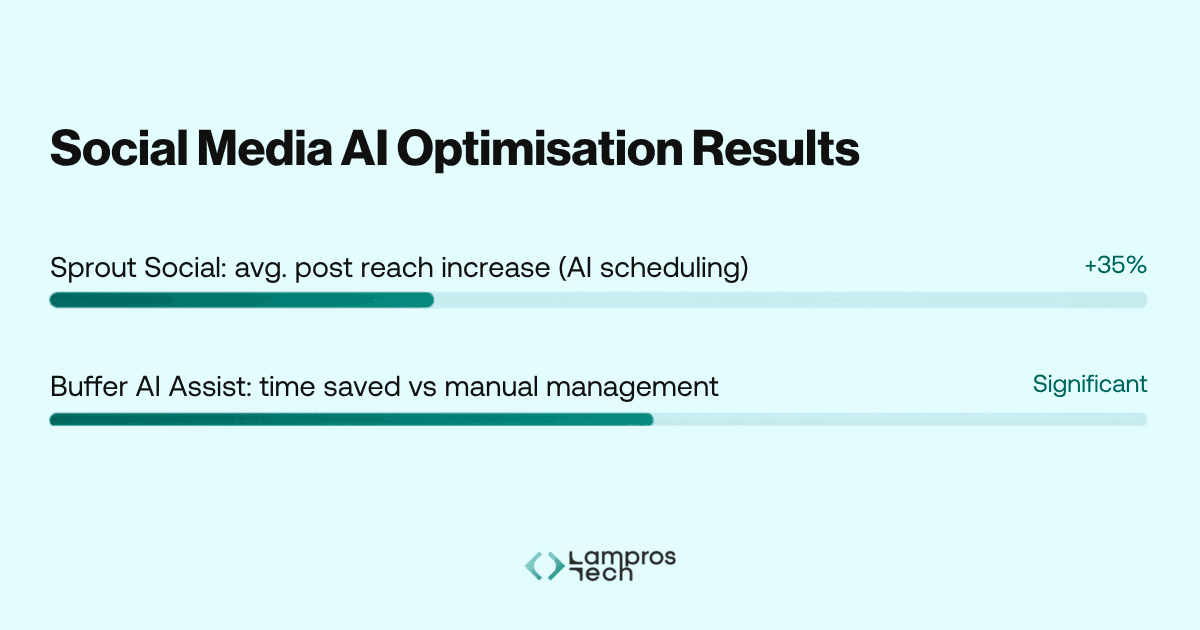
Sprout Social found AI-driven scheduling increased average post reach by 35% with no increase in posting volume or budget.
Buffer's AI Assist helped small businesses cut social media management time, while maintaining or improving engagement.
The pattern we see most often: businesses are leaving significant reach on the table simply by posting at the wrong time. Switching to AI-recommended scheduling is one of the fastest, lowest-cost improvements available.
Where to start: Pull your last 90 days of social data and run it through your platform's AI analytics. Switch to AI-recommended scheduling for 30 days and compare reach against your previous baseline.
Salesforce found sales reps spend only 28% of their week actually selling. The other 72% goes on admin, CRM updates, follow-up emails, meeting scheduling, and chasing data that should already be in the system.
AI sales automation removes that overhead entirely. It handles:
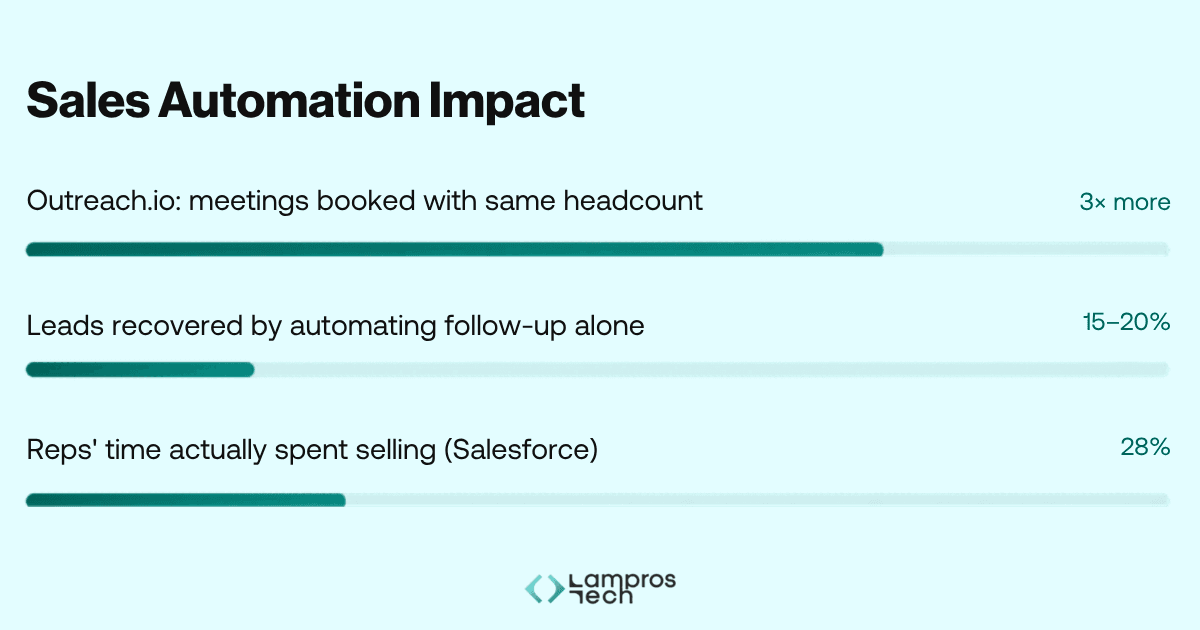
Outreach.io found sales teams using AI sequences booked 3x more meetings with the same headcount.
B2B teams, automating the follow-up sequence alone, without changing anything else, recovers 15 to 20% of leads that previously went cold. That recovery typically happens within the first 60 days.
Where to start: Map the five touchpoints that should happen after a lead enters your pipeline. Build an AI sequence to handle all five automatically. This single workflow is usually the fastest way to stop pipeline leaking from manual gaps.
Manual ad management is reactive by design. By the time a human reviews performance data, adjusts bids, and publishes the change, the budget has already been spent on the wrong audience. In real-time ad auctions, that lag is expensive.
AI-driven programmatic advertising removes it entirely. The system continuously adjusts:
Google's Performance Max delivers an average of 27% more conversions at a similar cost-per-action versus manually managed campaigns.
Meta's Advantage+ shopping campaigns report an average 32% lower cost per purchase compared to manually targeted equivalents.
The biggest resistance we see from businesses is reluctance to give up manual control. The data consistently shows that resistance is expensive.
Where to start: Run one campaign as Performance Max on Google or Advantage+ on Meta alongside your existing manual campaign for 30 days. The side-by-side data will tell you exactly what AI optimisation is worth before any broader commitment.
Two prospects with identical job titles and company sizes can be at completely different points in their buying decision. Sending them the same content at the same time serves neither of them.
Demographic segmentation tells you who your audience is. Behavioural segmentation tells you what they are ready to do next.
AI-based marketing automation clusters audiences dynamically using real-time signals:
It then triggers the next most relevant action automatically, a targeted email, a retargeting ad, a sales alert, or a personalised onboarding flow, based on what that specific person has actually done.
Adobe Experience Cloud enables fully automated journey orchestration across web, email, and paid from a single unified customer profile.
The businesses that get the most from behavioural segmentation always start with a single high-value trigger. One well-built trigger consistently outperforms an entire library of static segments.
Where to start: Identify one high-value behavioural signal, three pricing page visits in a week, or 60 days of inactivity from a previously engaged customer. Build one AI-triggered workflow around it. The lift over static segmentation will be immediate and measurable.
These use cases show that AI marketing automation is no longer limited to improving efficiency alone. Businesses are now using AI to make faster decisions, personalize customer experiences at scale, and optimize marketing performance in real time.
As competition increases and customer acquisition costs continue to rise, more companies are adopting AI-driven marketing workflows not just to stay efficient, but to stay competitive.
Understanding the use cases is one thing. Understanding why the urgency to act on them has never been higher is another.
The businesses moving fastest on AI marketing automation are not doing it because it is new or interesting.
They are doing it because the numbers make a compelling case, and because the cost of waiting is no longer neutral.
The most cited concern we hear from businesses considering AI marketing automation is whether the investment actually pays off. The data answers that question clearly.
A landmark McKinsey report on AI in marketing and sales found that businesses embedding AI across their marketing operations can generate up to 50% more leads, reduce marketing costs by 10 to 40%, and increase revenue by 3 to 15%, depending on the industry and depth of implementation.
These are not projections built on ideal conditions. They are benchmarks drawn from businesses that have already made the shift and measured the results.
The reason the gains are this significant comes down to three compounding advantages that AI creates simultaneously.
According to Forrester's Marketing Automation Report, businesses using AI-powered marketing automation reported higher lead-to-revenue conversion rates compared to those relying on manual or rule-based systems.
That gap is not explained by budget differences or team size. It is explained by process efficiency, and AI is the process upgrade.
Here is the part of this conversation that most AI marketing content avoids: not adopting is not a neutral position. Every month a business delays is a month a competitor is collecting better data, training better models, and building a compounding operational advantage that gets harder to close over time.
Gartner predicts that by 2027, organisations that embed AI into their core marketing operations will outperform competitors on marketing efficiency by a factor of 2x, not because they are spending more, but because every pound they spend is working harder.
What makes this particularly urgent for mid-market and SMB businesses is the window that still exists. Most markets have not yet reached saturation on AI marketing adoption.
The majority of businesses in most sectors are still in the planning or early-testing stage. That means the first-mover advantage in
The businesses that moved early on even one or two of the use cases in this guide are already seeing the compounding effect.
That advantage accumulates. And it started with a decision to act, not a decision to wait until the technology matured further or the timing felt more certain.
Salesforce's 2024 State of Marketing Report puts the picture into sharp focus: 83% of marketing teams that describe themselves as high performers are already using AI, compared to just 54% of underperforming teams.
The correlation between AI adoption and marketing performance is no longer a hypothesis. It is a documented pattern across thousands of businesses.
The question is not whether AI marketing automation delivers results. The data has answered that.
The real challenge for most businesses is knowing where to start and how to apply AI effectively within existing marketing workflows.
Most businesses that struggle with AI marketing automation do not fail because the technology is too complex.
They fail because they try to do too much at once. The businesses that succeed start narrow, prove value quickly, and scale from confidence rather than uncertainty.
Here is the three-step framework we use with businesses at every stage of AI marketing automation maturity.
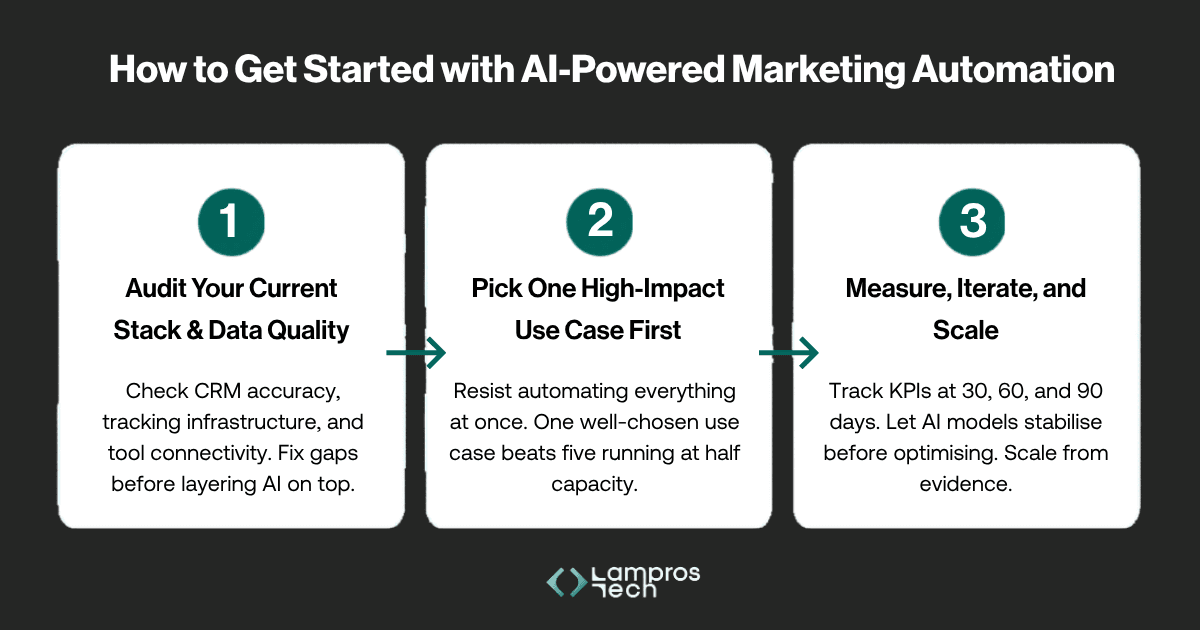
AI is only as good as the data it learns from. Before choosing a tool or picking a use case, get an honest picture of what you are working with.
Three areas to audit:
Fix the highest-priority gaps here before layering AI on top. A clean foundation is what separates implementations that compound over time from ones that plateau early.
Resist the temptation to automate everything at once. A single well-chosen use case executed properly beats five running simultaneously at half capacity every time.
Use these three questions to prioritise:
In our experience, email send-time optimisation, follow-up sequence automation, and chatbot deployment on high-traffic pages consistently deliver the fastest, clearest first results, typically within 30 to 60 days.
Getting AI live is not the finish line. The value compounds as the system learns, but only if you are actively measuring and feeding insights back into the process.
Track these five KPIs from day one:
Review at 30, 60, and 90 days against your pre-implementation baseline. Do not optimise on week-one data; AI models need sufficient volume before their outputs stabilise.
Three mistakes to avoid as you scale:
Once your first use case is delivering consistent results, apply the same methodology to the next.
Each implementation builds on the data and infrastructure of the previous one, which is exactly why early movers compound their advantage so quickly.
AI marketing automation is not a future investment to revisit when the timing feels right.
For the businesses pulling ahead in their markets right now, it is already the operational baseline, the difference between a marketing function that runs on manual effort and one that compounds its results automatically.
The eight use cases in this guide are not a wishlist.
They are a proven playbook. Businesses are using them right now to generate more qualified leads, close deals faster, reduce wasted ad spend, and free their teams to focus on the work that actually requires human judgment.
The data from McKinsey, Salesforce, Gartner, and the platforms themselves is unambiguous on the outcomes.
But knowing the use cases is only half of it. The businesses that see the strongest results are the ones that move from reading to implementation, starting with one high-impact use case, measuring it properly, and building from there.
If you are ready to identify the highest-impact AI marketing automation opportunity inside your funnel, we can help you map it out clearly.
Book my free AI marketing workflow strategy session, get a practical breakdown of where your current marketing process is slowing growth, which AI automation use cases will create the fastest ROI, and what to implement first without rebuilding your entire stack.

The most widely deployed AI marketing automation use cases are email personalisation, predictive lead scoring, AI chatbots, content creation, social media scheduling, sales pipeline automation, programmatic ad targeting, and behavioural segmentation. Each targets a specific funnel stage where manual processes create bottlenecks or revenue leakage. Among these, email personalisation and chatbot deployment consistently deliver the fastest ROI, typically within 30 to 60 days, because they address the two highest-cost inefficiencies in most marketing funnels: irrelevant messaging and slow response times. According to Gartner, AI-driven automation of marketing work is expected to more than double, from 16% in 2026 to 36% by 2028, signalling that adoption across these use cases is accelerating rapidly.
Traditional marketing automation follows fixed rules set manually, if a contact fills a form, send email A; if they visit a pricing page, trigger sequence B. The rules stay static until a human updates them. AI marketing automation learns from data continuously and improves decisions independently, identifying which leads are closest to converting, personalising content per individual, and adjusting ad bids in real time without manual reprogramming. The practical difference: traditional automation executes your strategy. AI marketing automation actively improves it while executing. According to Neuwark, marketing teams using AI-powered optimisation see 30% higher ROI on advertising spend compared to manual optimisation, a gap that widens the longer the model learns from your audience data.
Most businesses see measurable results from AI marketing automation within 30 to 60 days when starting with high-feedback use cases like email send-time optimisation, chatbot deployment, or automated follow-up sequences. Predictive lead scoring and behavioural segmentation take 60 to 90 days to stabilise as the AI model builds sufficient historical data. The compounding advantage, where each implementation makes the next more effective, becomes visible over a 6 to 12 month horizon. The critical variable is data quality. Businesses with clean CRM records, accurate tracking, and connected marketing tools consistently see results at the faster end of each window. Fragmented or incomplete data is the single most common reason implementations take longer than expected to show reliable output.
Yes, and the barrier to entry is lower than most small businesses assume. The highest-impact AI marketing automation features are already built into platforms small teams are likely using: send-time optimisation in Klaviyo and ActiveCampaign, AI content tools in HubSpot, and automated ad optimisation in Google Performance Max and Meta Advantage+. None require enterprise budgets or data science teams. Insider's research shows AI marketing automation helps reduce operational marketing costs by 12.2% and customer acquisition costs by up to 30 to 40%, outcomes proportionally more impactful for smaller businesses operating on tighter margins. The key is starting with one use case that removes a specific manual bottleneck rather than attempting a full-stack implementation from the start.
The biggest challenge is not the technology, but data quality and organisational readiness. Most implementations underperform because businesses deploy AI on top of fragmented, incomplete, or inaccurate data rather than fixing the foundation first. According to a Gartner survey of 402 CMOs, most organisations are stalled in at least one AI competency trap, where early success limits future progress because further investment stops delivering expected returns. The three issues we see most consistently are disconnected marketing tools sharing data poorly, removing human oversight before the model has enough data to be reliable, and selecting tools based on feature lists rather than fit with existing workflows and priority use cases.
Book Your Free AI Marketing Workflow Strategy Session
Get a practical breakdown of where your current marketing process is slowing growth, which AI automation use cases will create the fastest ROI, and what to implement first without rebuilding your entire stack.
Book My Free Strategy Session