
COO @ Quorivex Systems
We wanted to automate a few workflows but weren't sure where to start. Lampros helped us cut through the noise and get something useful into production quickly.

CTO @ Teralynx Systems
They picked up our processes surprisingly fast and built around how we already worked instead of forcing us into a new system.

Financial Technology Company
We saw value pretty quickly. A lot of repetitive work that used to take hours every week simply stopped being a problem. Our team could focus on higher-value work instead.
Contact Us
Ready to Ship AI Systems to
Let's align architecture, execution, and delivery from day one.
Published On Apr 30, 2026
Updated On May 20, 2026
AI workflow management in marketing is becoming critical for SaaS teams.
Not because AI is new, but because marketing automation today still runs on a mix of manual work and traditional automation that cannot keep up with growth.
Most teams operate in this hybrid state.
It works early on and breaks at scale.
Manual work slows things down, and rule-based automation cannot adapt.
So even with tools in place, growth becomes inconsistent and decision-making becomes harder under speed and complexity.
This is where AI workflow automation in marketing becomes necessary.
Not to add more automation, but to build systems that can:
In this blog, we’ll break down what AI workflow automation in marketing actually means, how it differs from traditional marketing automation, where it creates real impact, and how SaaS teams can implement it effectively without adding unnecessary complexity.
Let’s get started.
AI workflow management in marketing is the use of artificial intelligence to automate and optimize marketing processes by making real-time decisions based on data, user behavior, and context, rather than relying only on predefined rules.
In simple terms, AI marketing automation does not just execute tasks. It decides what should happen next.
But traditional systems work differently.
A typical marketing automation workflow looks like this:
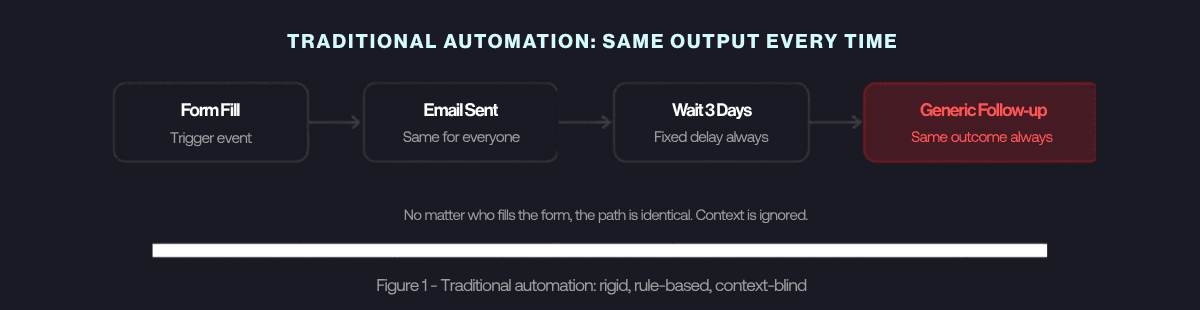
This approach works for stable workflows, where it assumes that every situation can be handled the same way.
But as systems grow, that assumption breaks.
Not all leads behave the same.Not all signals carry the same intent.And timing often matters more than the action itself.
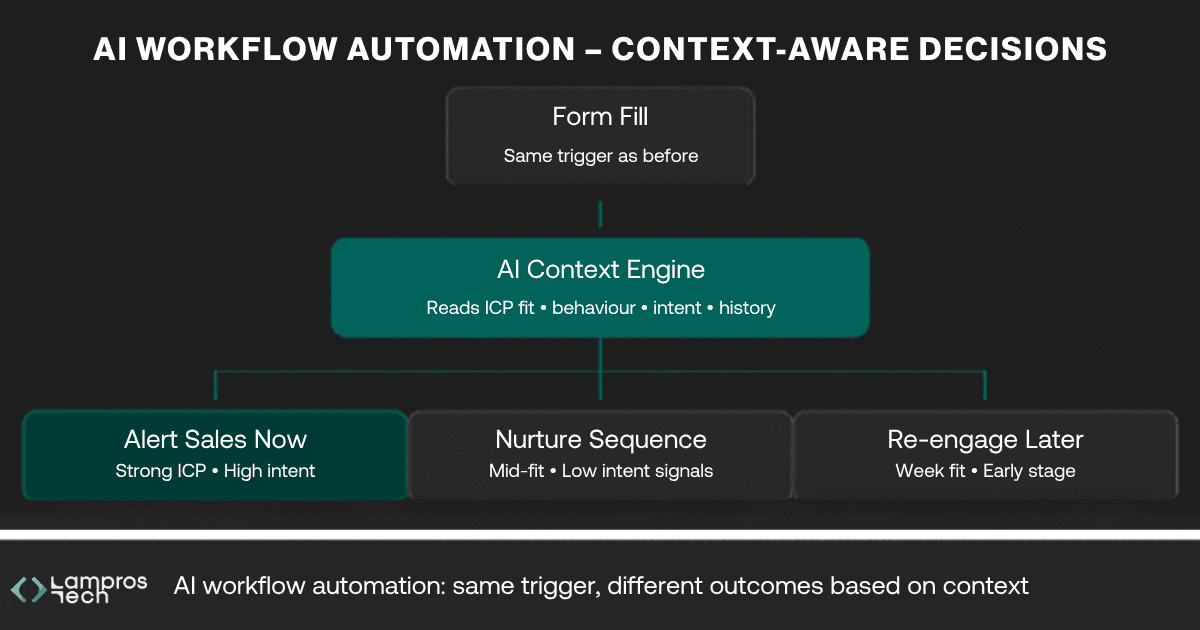
This is where AI-driven workflow automation changes how systems operate.
Instead of executing fixed instructions, it evaluates:
Then it determines the next best action.
Same trigger but a different outcome.
In practice, this difference becomes clearer when you look at how traditional automation and AI workflow automation behave side by side, especially as workflows scale and conditions become less predictable.
Today, most SaaS teams already use traditional marketing automation tools.
Email sequences are running. Campaign workflows are active. But as scale increases, these systems start to show limitations.
The difference becomes clear when you look at how decisions are made inside the workflow.
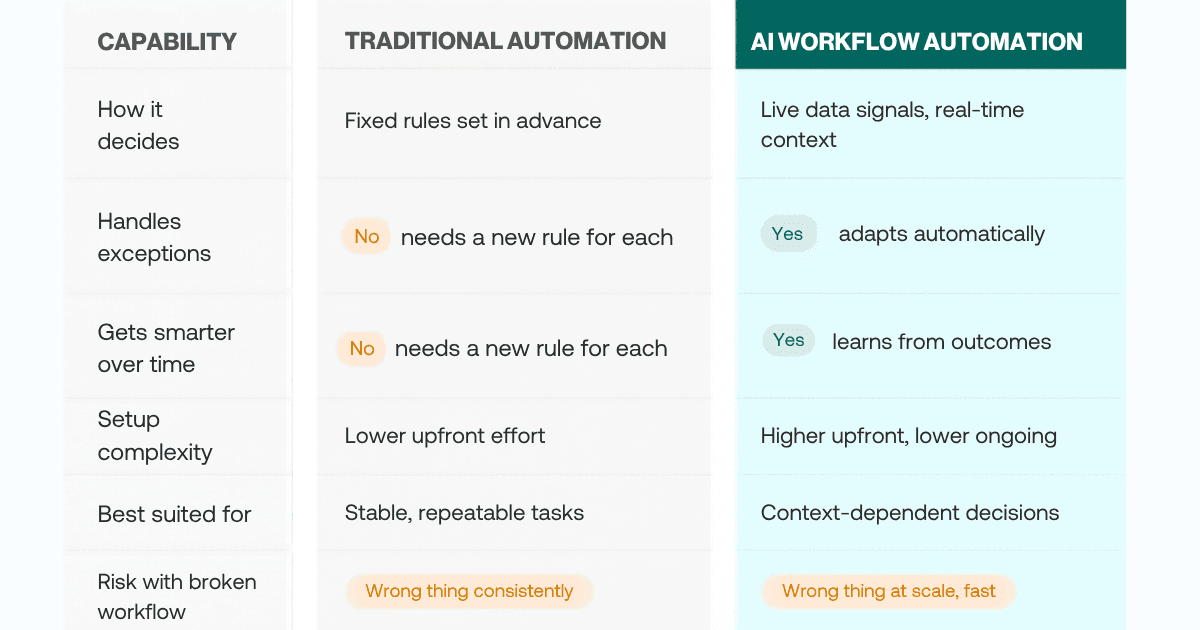
That last point matters more than it seems, as AI does not fix workflows, it amplifies them.
If the underlying decision logic is clear, AI improves speed and consistency.
If the logic is unclear or fragmented, AI scales those gaps just as quickly.
In practice, this is where teams run into issues.
Workflows are set up while tools are running. But decisions are still happening outside the system, across teams, spreadsheets, and delayed reviews.
So even with automation in place, the system does not behave predictably, and it happens to be a workflow design problem.
And it explains why many teams feel “automated” but still operate manually.
For most mid stage SaaS companies, the goal is not to replace traditional automation.
It is to use it where it works best, and extend it where it breaks.
That distinction is what makes the system scalable and it becomes more practical when you look at how it plays out inside real marketing workflows.
AI workflow management becomes meaningful when it improves how decisions are made within a marketing system, not just how tasks are executed.
But understanding how AI workflows operate is only one part of the picture. What matters more is how they are actually implemented in real-world teams.
Across companies, a consistent pattern emerges. The real gains come from reducing decision delays, improving decision quality, and connecting workflows end to end.
The following examples illustrate how this plays out across organizations at different stages.
Company: Salesforce
Problem:
As inbound lead volume increased, Salesforce relied on manual reviews and static scoring models. This created delays, with high-intent leads taking too long to reach sales teams.
Implementation:
Salesforce introduced Einstein Lead Scoring, an AI-driven system that evaluates behavioral signals and historical CRM data. By integrating with Data Cloud, it dynamically prioritizes leads across multiple product signals.
Result:
What changed: Lead prioritization moved from periodic review to continuous, real-time evaluation.
Platform: Google Ads
Problem:
Campaign optimization depended on manual bid adjustments and delayed reporting. Decisions were reactive and often based on outdated data.
Implementation:
Smart Bidding uses machine learning to evaluate billions of signals in real time, including user intent, device, location, and timing, to set optimal bids at the auction level.
Result:
What changed: Optimization shifted from manual updates to real-time decision-making at scale.
Company: Klarna
Problem:
Traditional creative production was expensive, slow, and dependent on external vendors, limiting campaign speed and scalability.
Implementation:
Klarna adopted generative AI tools and internal systems to automate content creation, image production, and localization workflows across the organization.
Result:
What changed: Creative workflows moved from manual production to AI-driven, scalable execution.
Company: SRV Media (Pune)
Problem:
Campaign performance relied heavily on manual optimization, making it difficult to respond quickly to changes in user behavior.
Implementation:
Adopted AI-driven bidding strategies within Google Ads to automate campaign optimization and decision-making.
Result:
What changed: Decision-making moved closer to real-time execution instead of post-analysis adjustments.
Across all cases, the improvement does not come from automating a single task.
It comes from:
Across all cases, the improvement doesn't come from automating a single task.
It comes from bringing decisions inside the workflow, reducing delay between signal and action, and allowing systems to adapt continuously.
And now the focus shifts to how to put this into action in a way that fits your current system.
Most implementation advice stops at “start small and scale.”
That’s directionally right. But not specific enough to be useful when you’re actually trying to make this work inside a lean SaaS team.
A more practical way to approach this is to think in terms of a short, controlled rollout. Not a full transformation.
Here’s what that typically looks like over a 90-day window.
Before introducing AI, understand how your team is currently operating.
Track the work being done over a typical week. Not just campaigns, but the small, repeated actions that keep things moving.
Look for patterns:
These are not just inefficiencies. They are signals of where workflows are not structured properly.
It’s tempting to fix multiple things at once. That’s usually where teams lose clarity.
Instead, focus on one workflow where both volume and decision variability are high.
For most Series A teams, this tends to be:
Improving one workflow end-to-end creates more leverage than partially improving several.
This is the step that determines whether AI will help or create noise.
Map the workflow at a basic level:
Then go deeper.
Ask:
Most workflows break here. Not at execution, but at unclear or inconsistent decision logic.
Only after the workflow is defined should tools come into the picture.
The goal is not to find the most advanced platform. It is to ensure that:
In practice, the best tools are often the ones that integrate cleanly with your existing stack.
Avoid switching entirely to the new system on day one.
Run the automated workflow alongside your existing process for a short period.
This allows you to compare:
What matters here is not initial performance, but stability.
Once the workflow is producing consistent results, then you can expand. Apply the same approach to the next workflow.
Over time, this creates a stack of clean, connected systems.
That’s where the real leverage comes from.
Not from one automated process, but from multiple workflows operating with consistent decision logic.
What we’ve seen is that teams who move this way tend to build systems that improve over time.
Teams that try to automate everything at once usually end up rebuilding. Because automation without structure does not scale and there are some hidden cost and challenges involved.
Implementing AI workflow automation in marketing does not usually fail because of the technology. It breaks at the system level.
Across SaaS teams, a few friction points show up repeatedly. Understanding these early makes implementation more predictable.
AI workflow automation depends on structured and reliable data. When CRM records contain duplicates, missing fields, or outdated information, the system still makes decisions, but they are based on incomplete context.
This leads to consistent but incorrect outcomes at scale.
What to address first:Run a focused CRM audit before implementation. Standardizing key fields and removing duplicates improves decision accuracy significantly.
AI introduces a shift in how decisions are made inside workflows. If it is not clear where the system decides and where humans intervene, teams tend to override or ignore automation.
This creates parallel workflows and reduces effectiveness.
In practice, resistance is rarely about the tool. It is about uncertainty in roles.
What to address first:
Clear ownership improves adoption and consistency.
Marketing workflows typically span multiple systems, CRM, campaign tools, analytics platforms, and internal processes.
If these systems are not properly connected:
This breaks the continuity required for AI workflow automation to function correctly.
What to address first:Map how data flows across your current stack. Identify where data is delayed, duplicated, or lost. Prioritize connection reliability over adding new tools.
Not every interaction in a marketing workflow should be automated.
When automation is applied across all touchpoints:
This is especially visible in mid-funnel and sales-assisted stages.
What to address first:
Identify key decision points where human involvement improves outcomes, such as high-value leads or complex deals. Automate around these moments, not through them.
Across these challenges, the pattern is consistent.
AI workflow automation performs well when workflows are clearly defined, data is reliable, and systems are connected.
When these conditions are not met, automation increases activity but does not improve outcomes.
AI workflow management in marketing is not changing all at once. It is evolving in stages, and most teams are already part of that transition without fully realizing it.
Right now, in 2026, the dominant model is AI-assisted workflow design.
AI is actively used across marketing systems, but its role is still bounded. It executes workflows that are designed by humans. Teams define the logic, select the tools, and decide how decisions should be made. AI improves speed and consistency, but the system itself remains human-directed.
The next shift, already beginning to take shape, is toward agentic marketing systems.
This is where most SaaS teams are operating today.
Early versions exist today, but reliable adoption is still developing.
This changes how marketing systems are structured and scaled.
Across all these stages, the pattern is consistent.
The advantage does not come from adopting AI early. It comes from having workflows that are already structured and connected.
If your workflows feel slow, fragmented, or dependent on manual decisions, AI workflow automation can restructure how your marketing system operates.
Lampros Tech works with SaaS teams to design and implement AI marketing automation workflows for these systems. Schedule a call to map where AI can create an immediate impact.

AI workflow automation in marketing is when systems handle execution and decide what should happen next based on real-time context, without requiring manual input at every step. Unlike traditional automation, AI reads who a lead is, how they've behaved, and what intent signals exist, then adjusts the response accordingly.
Traditional automation follows pre-written rules, every lead gets the same path regardless of context. AI automation evaluates each situation dynamically: company size, behaviour, ICP fit, intent signals. The outcome differs based on what's actually true about that specific lead at that specific moment.
For lead enrichment: Clay. For custom workflow building: n8n or Make. For AI-driven email outreach: Apollo.io or Instantly. For teams in HubSpot: HubSpot AI. For custom AI agents: Relevance AI. The most important rule: choose tools after defining the workflow, not before.
A practical first workflow, audit, design, build, test, and stabilise, typically takes 8 to 12 weeks for a lean SaaS team. The first 30 to 60 days often feel slower than before. That's normal. Stability matters more than initial speed. Once the first workflow is clean, subsequent ones move faster because the foundation is already in place.
Exploring AI automation but unsure how it fits your workflows?
If you’re navigating AI automation or figuring out how it fits into your workflows, we can help you map the right approach.
Let’s Talk