
COO @ Quorivex Systems
We wanted to automate a few workflows but weren't sure where to start. Lampros helped us cut through the noise and get something useful into production quickly.

CTO @ Teralynx Systems
They picked up our processes surprisingly fast and built around how we already worked instead of forcing us into a new system.

Financial Technology Company
We saw value pretty quickly. A lot of repetitive work that used to take hours every week simply stopped being a problem. Our team could focus on higher-value work instead.
Contact Us
Ready to Ship AI Systems to
Let's align architecture, execution, and delivery from day one.
Published On Apr 24, 2026
Updated On Apr 24, 2026

The question is no longer whether AI workflow automation belongs in your SaaS stack.
The question is how long you can afford to operate without it?
Here is the uncomfortable truth about AI in 2026:
88% of organisations are using it, but fewer than one in ten are actually seeing measurable business impact.
That is not a technology problem. That is an execution problem.
And at the heart of that execution gap sits one decisive capability: AI workflow automation.
McKinsey estimates that AI and automation together could add between $2.6 trillion and $4.4 trillion annually to the global economy, yet S&P Global found 42% of enterprises abandoned most AI initiatives in 2025.
The difference is not investment. It is implementation.
In this guide, we break down how AI workflow automation actually works, where it delivers real ROI, and how to implement it effectively.
Here is what you will take away:
Let's get into it.
AI workflow automation is the use of artificial intelligence, including machine learning, natural language processing, and intelligent decision engines, to design, execute, and continuously improve multi-step business processes without requiring a human to trigger or manage each step.
It connects systems, applies intelligence to data, makes context-aware decisions, takes action, and learns from outcomes to improve over time.
That last part, which learns from outcomes, is what separates it from everything that came before.
Traditional automation executes fixed instructions. It does exactly what you told it, every time, even when the situation has changed.
When an exception arrives, it breaks. Like someone files a ticket or fixes the rule. The cycle repeats indefinitely.
But AI workflow automation operates across three core layers:
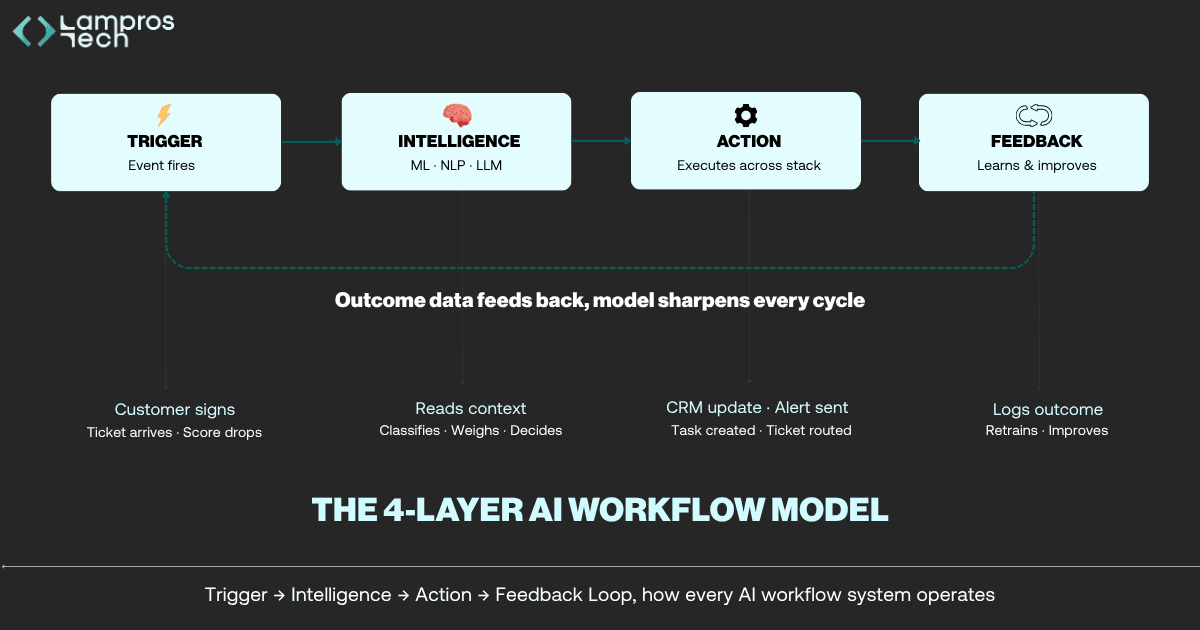
For SaaS specifically, this architecture matters because the workflows are rarely linear.
Rule-based automation cannot handle that complexity, but AI workflow automation is built for it.
One thing worth naming clearly, because vendor marketing blurs it constantly: AI workflow automation is not a chatbot, a co-pilot, or a dashboard with an AI summary button.
Those are AI-assisted tools.
Automation means the process runs, decisions get made, and actions get taken without a human in the loop at every step.
The human sets guardrails, monitors outcomes, and handles genuine exceptions. The system handles everything else but there is difference in traditional automation and AI workflow automation.
If you already have RPA running in your organisation, this question will come up in your next leadership meeting:
"We already automate. What exactly are we missing?"
It is the right question. Here is the honest answer.
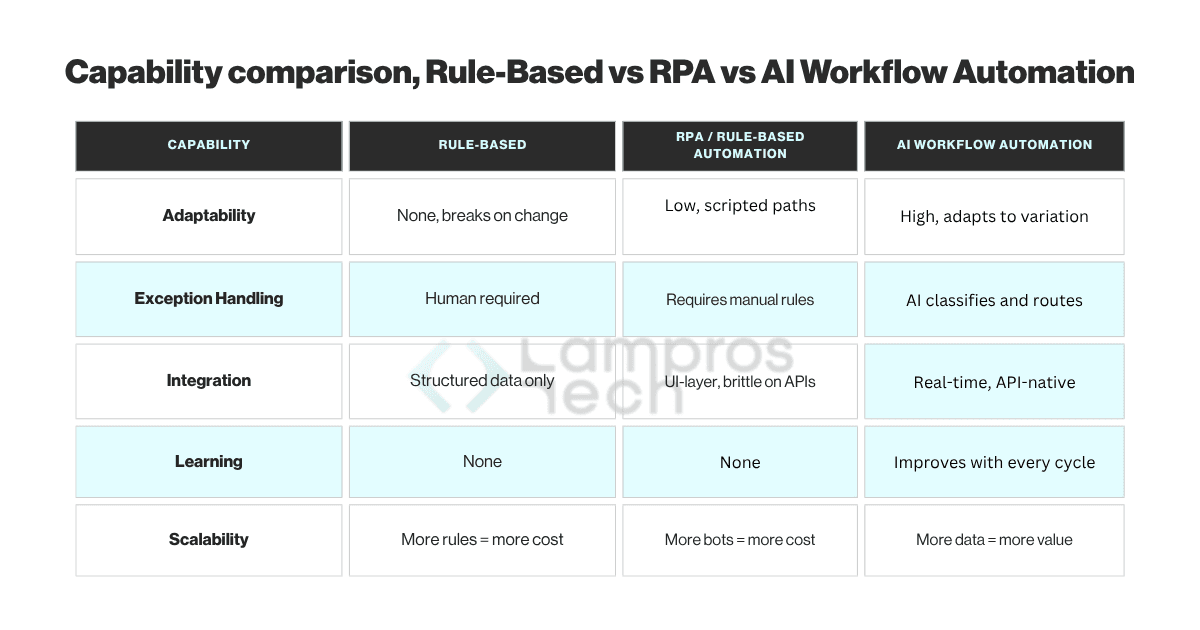
RPA automates tasks. AI workflow automation automates decisions.
RPA and rule-based tools are excellent at executing a defined sequence of steps against structured data, fast, consistent, and relatively cheap to deploy.
If your process is stable, exceptions are rare, and inputs never change format, RPA delivers solid ROI.
The problem is that almost no business-critical SaaS workflow looks like that.
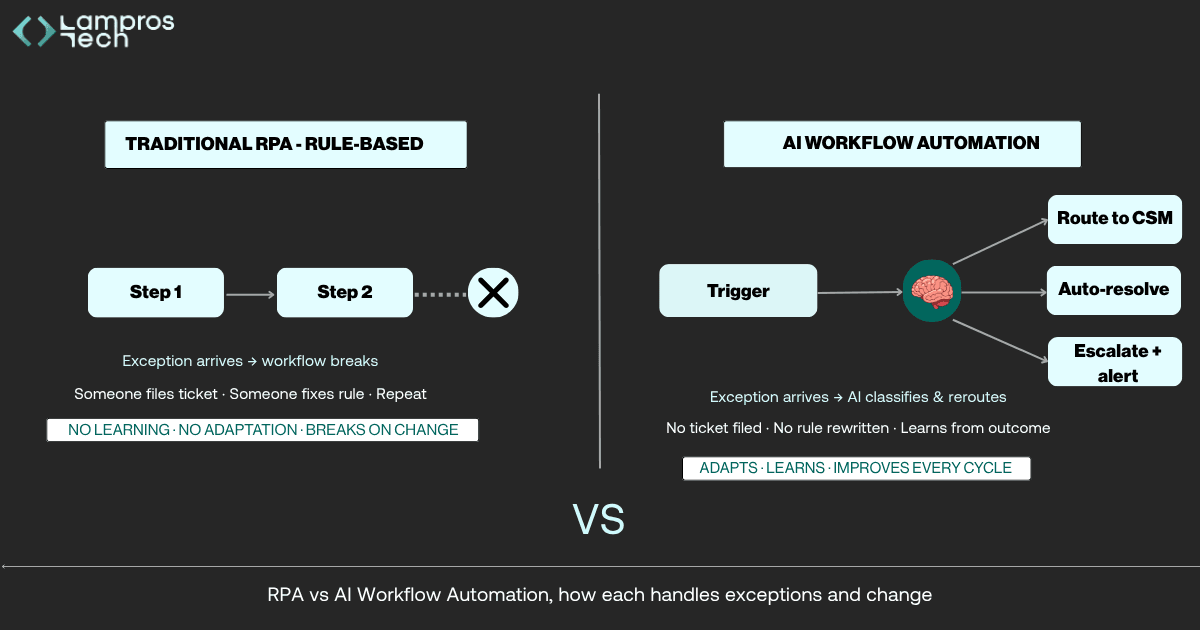
RPA is deterministic, it mimics steps using explicit rules and works well when inputs are structured and stable.
An AI workflow is an orchestrated loop that retrieves context, chooses actions, handles exceptions, and escalates only when confidence is genuinely low.
That difference does not sound dramatic until you know something is changed and is now broken.
Not necessarily. And any vendor telling you to rip and replace everything is selling, not advising.
Most organisations progress along a maturity curve:
task automation → process automation → intelligent automation → hyperautomation
RPA is often the entry point. Intelligent automation builds on that foundation to enable scalable, decision-driven processes.
The strategic question for your team is not which technology to pick.
It is where on that maturity curve your most critical workflows currently sit, and what it is actively costing you to keep them there.
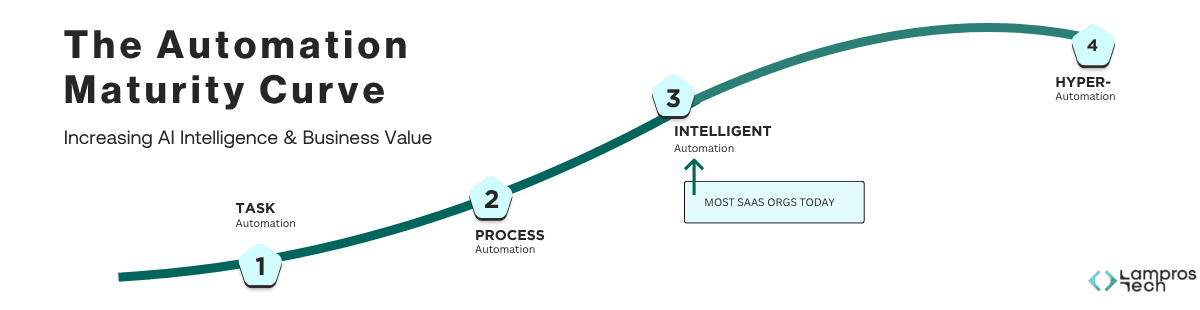
That position on the curve determines how your workflows behave today, and where they start to break as complexity increases.
The next step is understanding what actually changes as you move forward on that curve.
Because the shift is not just conceptual. It is architectural.
To see how that plays out in practice, we need to look at how AI workflow automation systems are structured and how decisions move through them.
Let’s break down how AI workflow automation actually works.
You do not need to understand the model architecture to make smart decisions about AI workflow automation.
But you do need to understand the operational architecture, because that is what determines whether systems scale reliably or fail under real-world complexity.
This architecture can be broken down into four layers:
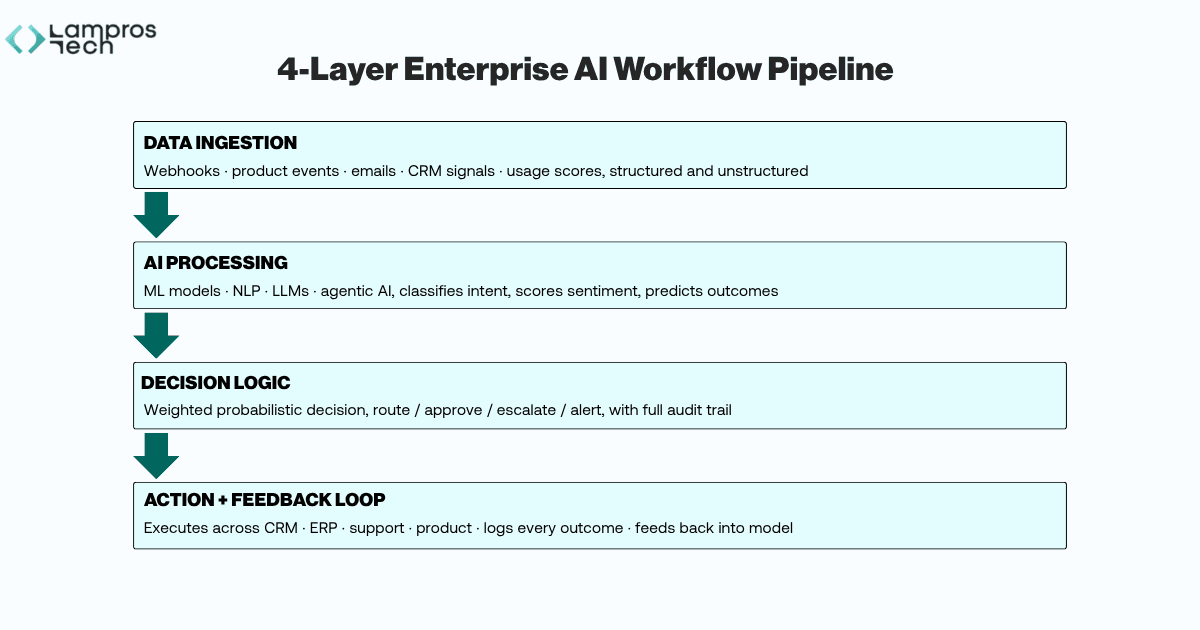
Everything starts with a trigger and data flowing in, structured or unstructured.
The system ingests this, structured or unstructured, and prepares it for the intelligence layer above.
This is where the intelligence lives.
The system interprets data using ML models, NLP, and LLMs. It classifies intent, extracts entities, scores sentiment, predicts outcomes, and builds context.
Leading platforms in 2026 have AI agents embedded directly into the decision layer, making multi-step decisions autonomously, not just triggering rule-based branches.
Armed with context, the system decides what happens next. This is not an if/then rule, it is a weighted, probabilistic decision based on all available signals.
Route a ticket to tier-2 support.
The system does not just act, it explains why it acted, which is critical for compliance and auditability.
The system executes across your connected stack, CRM updates, messaging, task creation, escalation notifications, logs every action, and feeds outcome data back into the model.
Every cycle sharpens the next decision. Without this feedback loop deliberately designed in, you have intelligent automation at launch.
With it, you have a system that compounds in value every quarter.
This architecture shows that AI workflow automation is not a single capability, but a connected system of data, decisions, and execution.
The real shift is from static processes to workflows that adapt and improve over time.
The next question is what this delivers in practice.
Let’s look at why AI workflow automation boosts productivity.
Productivity is not the reason most executives sign off on AI workflow automation.
They invest in what productivity unlocks, engineering hours redirected to product, faster sales cycles, and support costs that stop scaling with headcount.
AI workflow automation boosts productivity by reducing manual work, improving decision speed, and enabling teams to focus on high-impact tasks.
The Headline Data
Generic productivity statistics tell you automation works. But what they rarely tell is where it works hardest in a SaaS business.
Three levers consistently deliver outsized returns.
Every SaaS company has revenue-adjacent processes running on manual effort, lead routing dependent on an analyst, renewal alerts triggered by someone remembering to check a spreadsheet, contract approvals stuck in email threads.
These are compounding revenue risks dressed up as workflow problems.
AI automation eliminates the lag between signal and action.
In SaaS, speed of response directly correlates with conversion and retention.
Onboarding is where churn is won or lost, long before the first renewal conversation.
Automating trigger-based onboarding sequences, provisioning, health score monitoring, and early intervention alerts does not just save CSM time.
It shortens the window between a customer signing and a customer seeing value.
That compression has a direct, measurable impact on expansion revenue and NRR and it directly improves expansion revenue and NRR.
ServiceNow's own environment demonstrates what high-value workflow automation looks like at scale, 89% of customer self-service requests were supported by AI in 2025, saving employees more than 2.3 million hours.
That is not a feature. That is a structural cost advantage that compounds every quarter you maintain it.
Most ROI discussions fail because they focus on cost savings.
That is the wrong frame.
The real question is: which workflows generate measurable return?
High-impact automation targets:
Translate this into engineering output.
If each engineer recovers 15 hours per week through automation, from code reviews, incident triage, and approvals, that is 60+ hours of product development per month per engineer.
That is the real productivity number. Not a percentage. An output.
Here are some real world application of AI workflow automation in practice.
The use cases below are not hypothetical.
They are the workflows where SaaS companies are deploying AI automation right now and seeing measurable returns in 2026.
The pattern across all of them is consistent: the best automation targets repetitive admin, high-volume coordination, slow handoffs, and predictable decisions.
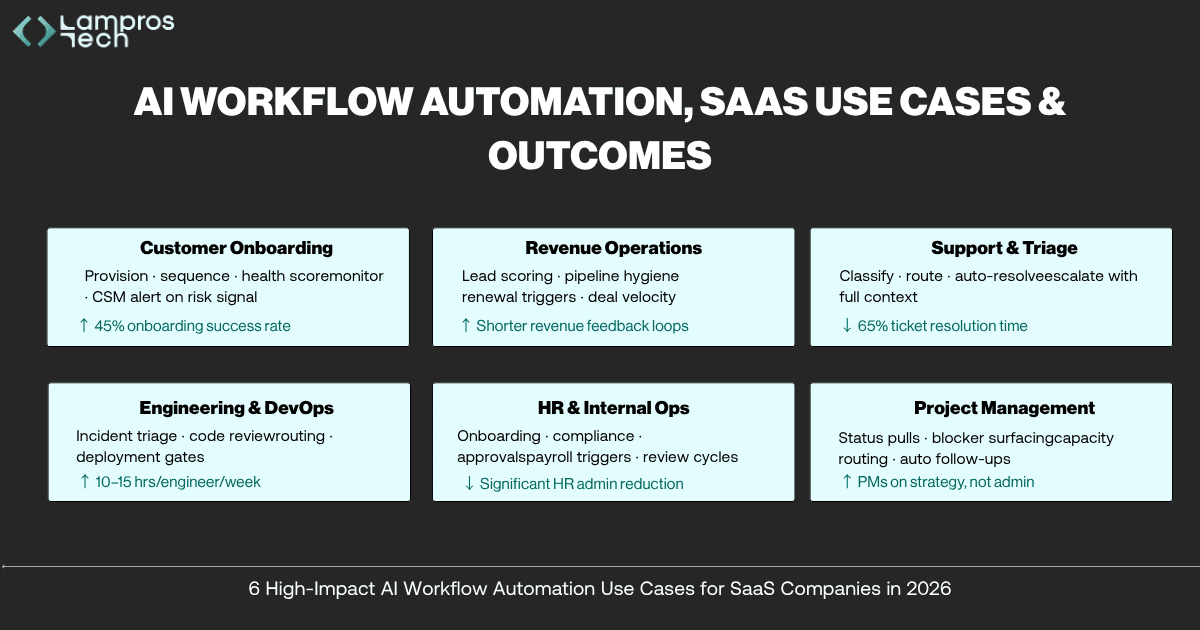
The moment a contract is signed, the workflow fires, provisioning the account, triggering a personalised onboarding sequence, monitoring early engagement signals, and alerting the CSM only when a health score drops below threshold.
The result: increase by 45% improvement in successful onboarding rates.
Lead scores update in real time based on product usage signals.
Pipeline hygiene runs on a schedule. Renewal workflows trigger 90 days out, pulling in usage data, stakeholder mapping, and competitive signals to arm the account team before the conversation starts.
The result: increase shorter feedback loops across entire revenue team.
Tickets are classified by intent, urgency, and sentiment the moment they arrive.
Routine requests resolve automatically.
Complex issues route to the right tier with full context already assembled. Escalation fires based on account health, not just ticket priority.
The result: 65% reduction in ticket resolution time.
Incident classification fires the moment an alert triggers, routing to the right engineer with a pre-assembled diagnosis.
Code review assignment based on codebase familiarity.
Deployment gates trigger automatically based on test coverage and risk scoring.
The result: 10-15 hours recovered per engineer per week
New hire onboarding triggers across IT provisioning, payroll, compliance documentation, and manager notifications from a single event.
Expense approvals route based on policy logic.
Performance review cycles trigger, collect, and synthesise automatically on schedule.
The result: Significant reduction in HR admin overhead
Status updates pull automatically from connected tools.
Blockers surface before they delay a sprint. Task assignments route based on capacity data.
Meeting follow-ups generate and distribute without anyone writing them. PMs spend time on decisions, not chasing information.
The result: Eliminated manual coordination overhead.
Across these use cases, the pattern is clear.
The highest impact does not come from automating isolated tasks.
It comes from redesigning workflows so decisions, coordination, and execution happen without delay.
That is where the real gains show up, in speed, consistency, and the ability to scale without adding operational overhead.
But these systems do not work by default.
Most implementations fail not because the technology is limited, but because the design, data, and execution layers are not aligned.
To understand where things break and how high-performing teams avoid it, we need to look at the challenges.
Most vendor content on AI workflow automation stops at the use cases and glosses over the failure modes.
That is not useful if you are a CTO or CEO making a real investment decision.
Here are the four challenges that account for most failed implementations and what the companies that succeed actually do differently.
AI automation amplifies whatever is in your data.
If your CRM data is 60% accurate, your automated workflows will be 60% accurate, at scale, and at speed.
The most common mistake is treating data quality as something to fix after implementation begins. It needs to come first.
Fix: Data governance audit before automation build, not after
As no-code platforms democratise workflow building, teams across the business start deploying automations outside IT's visibility.
The individual workflows are often well-intentioned and functional.
The aggregate risk, undocumented processes, ungoverned data access, no fallback logic, is significant.
By 2027, Gartner projects 75% of employees will acquire or build technology without IT oversight.
Fix: Governance framework established before no-code access is opened up
The number one reason AI automation initiatives fail is not the technology.
It is adoption. Teams resist workflows they do not trust or understand.
Managers resist processes they cannot override. The implementation gets technically shipped and operationally ignored.
The fix is not a training session, it is involving the workflow owners in the design process from the start, so the automation reflects how they actually work, not how someone assumed they work.
Fix: Co-design with workflow owners, not just delivery to them
Not every step in a workflow should be automated.
Customer trust moments, compliance decisions requiring human judgement, and genuinely novel exceptions all benefit from human involvement.
The companies that extract the most value from AI automation are the ones that are clear-eyed about where human judgement adds value and deliberately keep humans in those specific loops while automating everything else.
Fix: Design human checkpoints intentionally, do not automate around them
AI workflow automation is not an IT project.
It is a business architecture decision and the companies treating it as the former are generating the abandonment statistics, while the companies treating it as the latter are quietly compounding advantages that will be very difficult to close in 18 months.
The data in 2026 is unambiguous. 88% of organisations are using AI.
Only 6% qualify as high performers, seeing significant bottom-line impact.
The gap is not technological, the tools exist, they work, and they are more accessible than ever.
The gap is strategic: knowing which workflows to start with, how to implement without creating the data and governance debt that sinks most projects, and how to build the organisational capability to scale what works.
Start with one workflow. Define success before you build. Measure for 30 days.
Then scale what works.
That discipline, applied consistently is what separates the SaaS companies compounding automation value every quarter from the ones still running the same pilot they launched 18 months ago.
Knowing that AI workflow automation delivers results and actually making it work in your organisation are two different things.
Most SaaS teams have the intent. What they lack is a partner who understands both the technology and how workflows operate in practice.
That is what Lampros does.
We build, integrate, and scale AI workflow automation systems that move from pilot to production and actually deliver outcomes.
Our approach is simple: start narrow, prove value fast, then scale with the right infrastructure. If you want to see what that looks like for your workflows, you can book a call with our team now.

AI workflow automation is the use of artificial intelligence, including machine learning, natural language processing, and intelligent decision engines, to design, execute, and continuously improve multi-step business processes without requiring a human to trigger or manage each step.
Unlike traditional rule-based automation, AI workflow automation adapts to new data, handles exceptions intelligently, and improves its own decision-making over time.
For SaaS businesses, it operates across functions including customer onboarding, revenue operations, engineering pipelines, and customer support, turning repetitive, decision-heavy processes into scalable, self-improving systems.
RPA is a robotic process automation that executes fixed, rule-based instructions against structured data. It does exactly what it is programmed to do, every time, even when the situation has changed. When an exception arrives, it fails. AI workflow automation works differently. It reads context, interprets unstructured data, makes weighted probabilistic decisions, and reroutes intelligently when something unexpected happens. The critical distinction is this: RPA automates tasks. AI workflow automation automates decisions. For SaaS companies managing complex, branching workflows across multiple systems, that difference compounds significantly over time, both in performance and in the cost of maintaining the system at scale.
Most AI workflow automation implementations fail for four consistent reasons. First, data quality, AI amplifies whatever is in your data, so poor CRM or product data produces poor automated decisions at scale and at speed. Second, shadow IT risk, as no-code tools democratise workflow building, teams deploy automations outside IT governance, creating undocumented processes with no fallback logic. Third, change management, the technology ships, but the team does not adopt it, because workflow owners were not involved in the design. Fourth, over-automation, removing human judgment from decisions that genuinely require it, creates compliance gaps and customer trust failures. The companies that succeed treat implementation as an organisational design challenge, not a technical deployment.
The highest-impact AI workflow automation use cases in SaaS cluster around five functions. Customer onboarding, automating provisioning, personalised sequences, health score monitoring, and CSM alerts reduces time-to-value and improves onboarding success rates by up to 45%. Revenue operations, real-time lead scoring, automated pipeline hygiene, and 90-day renewal triggers shorten feedback loops across the entire go-to-market team. Customer support, AI-powered ticket classification and routing reduces resolution time by up to 65% while cutting support costs. Engineering and DevOps, automated incident triage, code review routing, and deployment gates recover 10 to 15 hours per engineer per week. HR and internal operation, new hire onboarding, compliance tracking, and approval workflows triggered from a single event eliminate manual coordination overhead across the organisation.
Implementing AI workflow automation without burning budget comes down to five disciplines. Start with an audit, map your ten highest-friction workflows and calculate the true cost of each in time, headcount, and error rate. Prioritise using an impact matrix, plot automation candidates on effort versus value and start in the high-value, low-complexity quadrant. Run a narrow pilot, choose one non-critical, high-repetition workflow, define success metrics before you build, and measure for 30 days against a baseline. Integrate with governance, connect to your live data layer only after establishing data ownership, access controls, and fallback logic. Scale with ownership, assign automation to a Centre of Excellence with business-side ownership, not just IT. The organisations that extract compounding value from AI workflow automation are the ones that treat it as a business architecture decision from day one, not an IT deployment.
Ready to identify your first high-value automation opportunity?
In one focused consultation, we map your highest-friction workflows, identify the best automation candidates, and give you a clear 30-day pilot roadmap, at no cost.
Book Your Free Consultation