
COO @ Quorivex Systems
We wanted to automate a few workflows but weren't sure where to start. Lampros helped us cut through the noise and get something useful into production quickly.

CTO @ Teralynx Systems
They picked up our processes surprisingly fast and built around how we already worked instead of forcing us into a new system.

Financial Technology Company
We saw value pretty quickly. A lot of repetitive work that used to take hours every week simply stopped being a problem. Our team could focus on higher-value work instead.
Contact Us
Ready to Ship AI Systems to
Let's align architecture, execution, and delivery from day one.
Published On Mar 30, 2026
Updated On May 20, 2026

88% of organisations now use AI in at least one business function, yet only 6% report meaningful impact on profitability.
The gap between those two numbers, 82 percentage points of wasted investment, is the real story of AI in 2026.
This is not a technology problem. The models work. The tools are widely available.
The gap is entirely an execution-and-strategy problem. And it is widening, not closing, as more companies pile into AI adoption without the workflow discipline to turn it into outcomes.
This piece covers what the market landscape and the latest AI breakthroughs in 2026 actually mean for SaaS businesses.
Let’s get started.
SaaS grew by solving a distribution problem.
On-premise software was expensive to deploy, painful to maintain, and impossible to update at scale.
Cloud delivery removed all three constraints.
Deployment cycles dropped from months to hours. Updates became continuous. Pricing shifted from upfront cost to subscription.
That structural shift drove adoption across industries.
By 2025, the global SaaS market was valued at $408 billion, according to Precedence Research, on a trajectory toward $1.25 trillion by 2034.
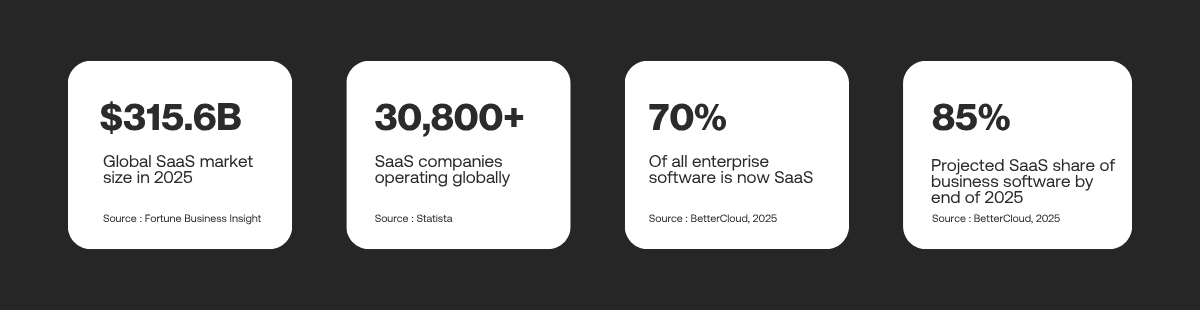
The numbers show how deep this penetration is.
Market size estimates vary based on the definition.
Some reports place the 2025 market at around $315 billion, focused on core SaaS products. Broader estimates, including platform and adjacent layers, push this above $400 billion.
The exact number matters less than the signal.
SaaS is no longer early stage. It is fully embedded.
Now look at how that growth evolved.
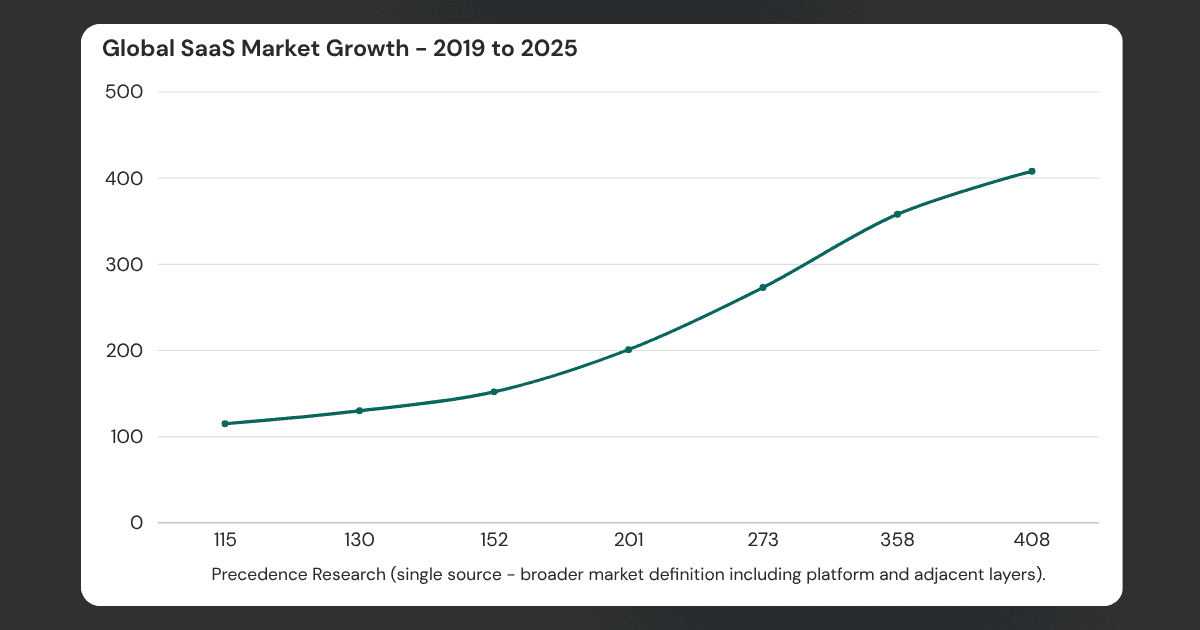
The market grew from roughly $115 billion in 2019 to over $400 billion in 2025.
Early phase SaaS often grew at 25 to 40 per cent annually. Current growth is closer to 12 to 15 per cent.
Growth continues. Acceleration has slowed.
This is what maturity looks like.
In an expansion phase, growth comes from new categories. In a mature phase, growth comes from replacement.
Most companies already run on SaaS. The decision is no longer whether to adopt. The decision is what to replace.
That shift changes the market.
Companies are not competing against no solution, but are competing against something already embedded.
That is the market AI is entering.
The shift in SaaS is no longer about adding more tools or expanding categories. It is about changing how software operates at its core.
AI is not entering SaaS as another feature. It is changing how software operates across the stack.
It affects every layer of the stack.
This is not a single category shift. It cuts across the entire stack.
That is why it feels different. And the data reflects the speed of this change.
Global spending on AI-enabled applications is projected to reach $2.5 trillion in 2026, growing 44% year-on-year.
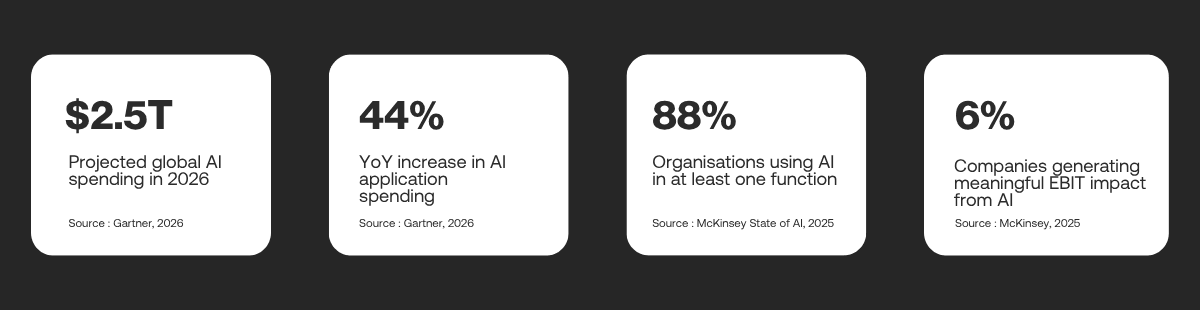
That last number deserves attention.
Around 88% of organisations now use AI in at least one business function, but only 6% are genuinely moving the needle on profitability.
There's a wide gap between adoption and execution, and it's where most of the real strategic risk sits right now.
The clearest signal of how this gap gets closed is not in the data.It is in how the people building and running software are thinking about the shift.
In early 2026, Microsoft CEO Satya Nadella put it directly:
“All of us are going to be managers of an infinite mind. Young people today may not manage lots of people at age 20 or 21, but they will be managing a team of agents.”
That framing changes the lens.
Most companies are still adding AI into existing workflows, while leaders are thinking in terms of systems built around agents.
That is the difference between adoption and execution.
Adoption integrates AI into the current model, while execution redesigns the model around AI.
And once that shift happens, the role of software changes.
The impact does not stop at the product layer. It is already visible inside engineering teams, where AI is changing how software gets built, not just how it behaves.
Around 66% of engineering teams now use AI tools in production, and programmers who use AI can code 126% more projects per week.
Developer usage has also risen from 44% to 62% in a single year, reflecting how quickly AI has moved into the core development workflow.
The Pragmatic Engineer’s March 2026 survey shows how far AI adoption has moved. Around 95 per cent of developers now use AI tools weekly.
This is no longer early adoption. It is near-universal usage among active engineers.
Claude Code went from zero to the most-used AI coding tool in eight months, now nearly as widespread as GitHub Copilot was three years ago.
Tool usage is also fragmenting. Around 70 per cent of developers use two to four AI tools at the same time.
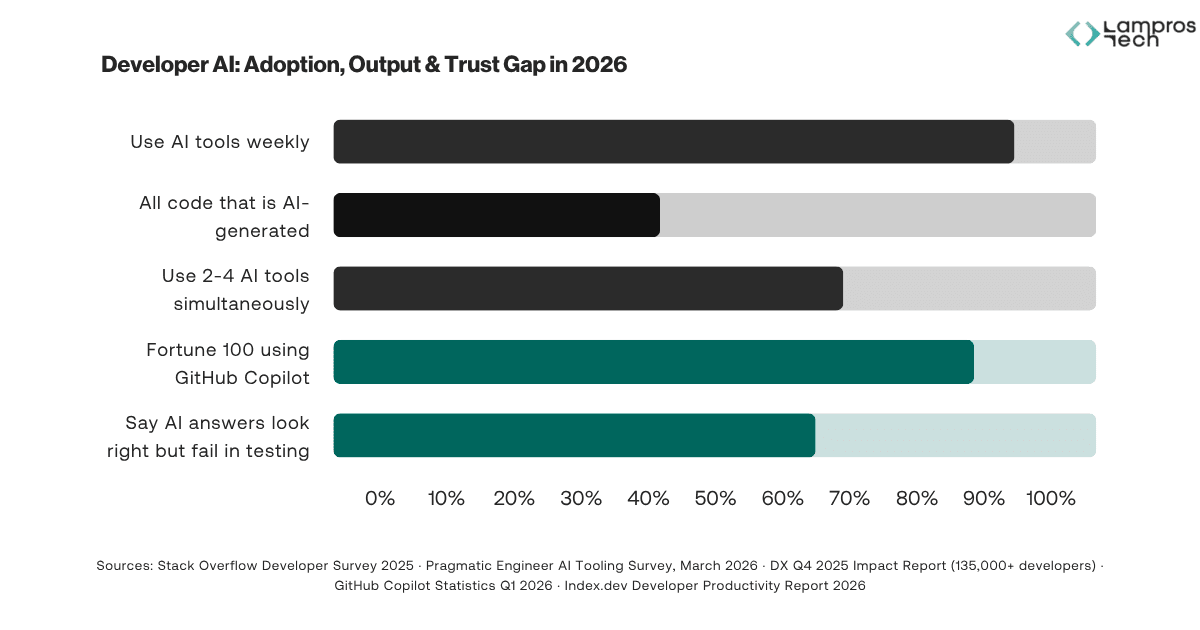
On the output side, AI is already shaping codebases. Around 41 per cent of code is AI-generated in some environments.
But output does not equal reliability.
Even in widely adopted tools like GitHub Copilot, only about 30 percent of suggestions are accepted into production code.
But the trust gap is widening, not closing.
Developers use AI constantly, but they do not fully trust it.
Around 66 per cent report that AI outputs often look correct but fail during testing. This points to a deeper issue. AI can generate code, but it lacks the full context of the system it operates in.
This changes how engineering teams need to operate.
Leaders can no longer manage based only on developer output. They need systems that validate AI-generated code, enforce testing rigour, and define clear boundaries for where AI can be trusted.
The term agentic AI has gained traction over the past year, but the shift it represents is often misunderstood.
AI assistants do things on behalf of humans, autonomously, across multiple systems, with the ability to make decisions and take actions without step-by-step input.
This shift is already underway.
As per Gartner, fewer than 5% of enterprise applications today have embedded task-specific AI agents. By the end of 2026, that number is projected to reach 40%.
This changes what software is expected to do.
Software is no longer evaluated on features. It is evaluated on whether it can complete a workflow end-to-end.
That is where the impact shows up.
For example:
A support tool that surfaces tickets is useful. An AI system that resolves tickets without human input replaces the tool entirely.
This is the transition from assistance to execution.
But not every SaaS product will be affected in the same way.
The level of disruption depends on two variables:
Bain & Company's 2025 Technology Report maps these two axes into four distinct scenarios.
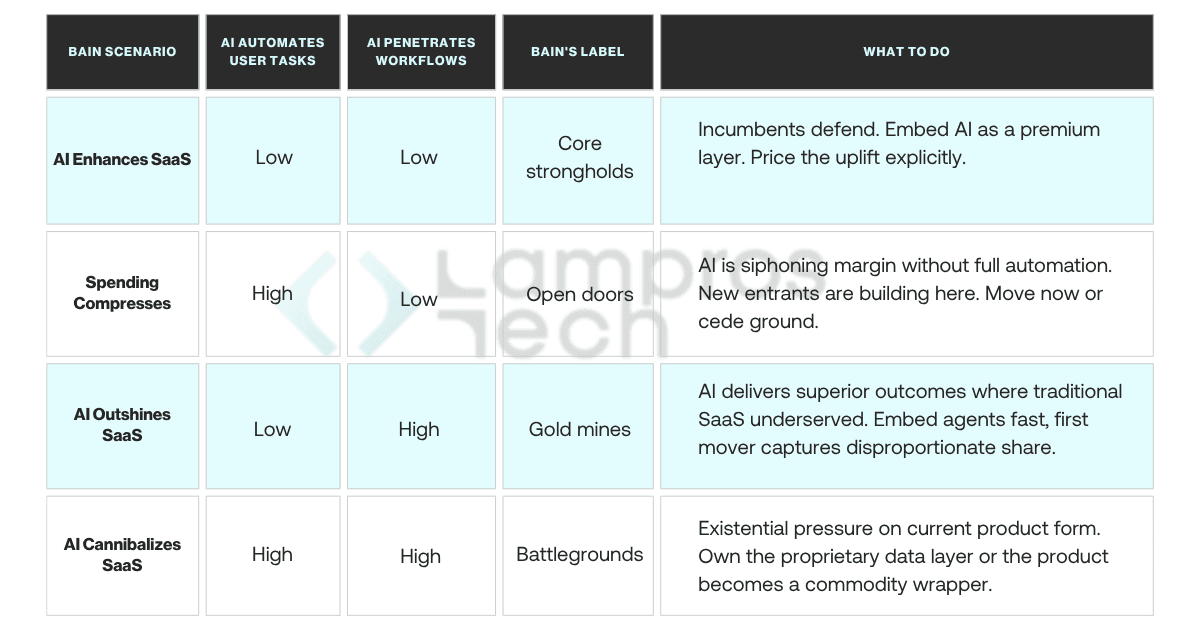
Most products will move toward compression.
Very few will own the workflow.
That is where value is concentrated.
The data throughout this shift point to a consistent pattern.
AI adoption is not the constraint. Execution is.
Most companies are still using AI to improve existing workflows.A smaller group is using it to change how those workflows are structured in the first place.
That difference is where outcomes start to diverge.
Over the next 24 months, this shift will not show up as disruption headlines.
It will show up in:
At Lampros Tech, this is how we approach AI systems.
Not as features to add, but as workflows to redesign.Not to assist users, but to execute reliably in production.
Because in this phase of the market, that is where the advantage is built.

AI in SaaS refers to embedding machine learning and language models into software products to automate workflows, generate outputs, and make decisions without manual intervention. Unlike traditional SaaS, which relies on users to operate dashboards and execute steps, AI-driven SaaS systems interpret intent and execute tasks autonomously. This shifts software from tool-based interaction to outcome-driven execution.
While around 88% of organizations use AI in some form, only a small percentage achieve meaningful business impact. The gap exists because most companies treat AI as a feature rather than redesigning workflows around it. Adoption improves efficiency, but execution-driven systems deliver results. Without aligning AI to specific workflows and measurable outcomes, ROI remains limited.
AI is transforming SaaS architecture by introducing an execution layer on top of traditional systems. Instead of static interfaces, modern SaaS products integrate AI agents that interpret user intent, coordinate across systems, and execute workflows. This shifts architecture from system-of-record models to system-of-execution models, where value is defined by outcomes rather than features.
Agentic AI refers to systems that can independently perform tasks, make decisions, and execute workflows across multiple tools without continuous user input. In SaaS, this means moving from assistants that support users to agents that replace manual steps entirely. As adoption grows, products that cannot support autonomous execution risk becoming commoditized.
SaaS leaders should focus on redesigning workflows rather than adding AI features. The priority should be identifying high-impact use cases, integrating AI into core system logic, and ensuring reliability in production. Success depends on execution quality, not adoption speed. Companies that align AI with measurable outcomes and system-level changes will outperform those treating it as an add-on.
Build AI Systems That Actually Work in Production
Move beyond experiments. Design AI systems with the right architecture, data, and workflows to deliver real business impact.
Let’s Talk