
COO @ Quorivex Systems
We wanted to automate a few workflows but weren't sure where to start. Lampros helped us cut through the noise and get something useful into production quickly.

CTO @ Teralynx Systems
They picked up our processes surprisingly fast and built around how we already worked instead of forcing us into a new system.

Financial Technology Company
We saw value pretty quickly. A lot of repetitive work that used to take hours every week simply stopped being a problem. Our team could focus on higher-value work instead.
Contact Us
Ready to Ship AI Systems to
Let's align architecture, execution, and delivery from day one.
Published On May 15, 2026
Updated On May 15, 2026
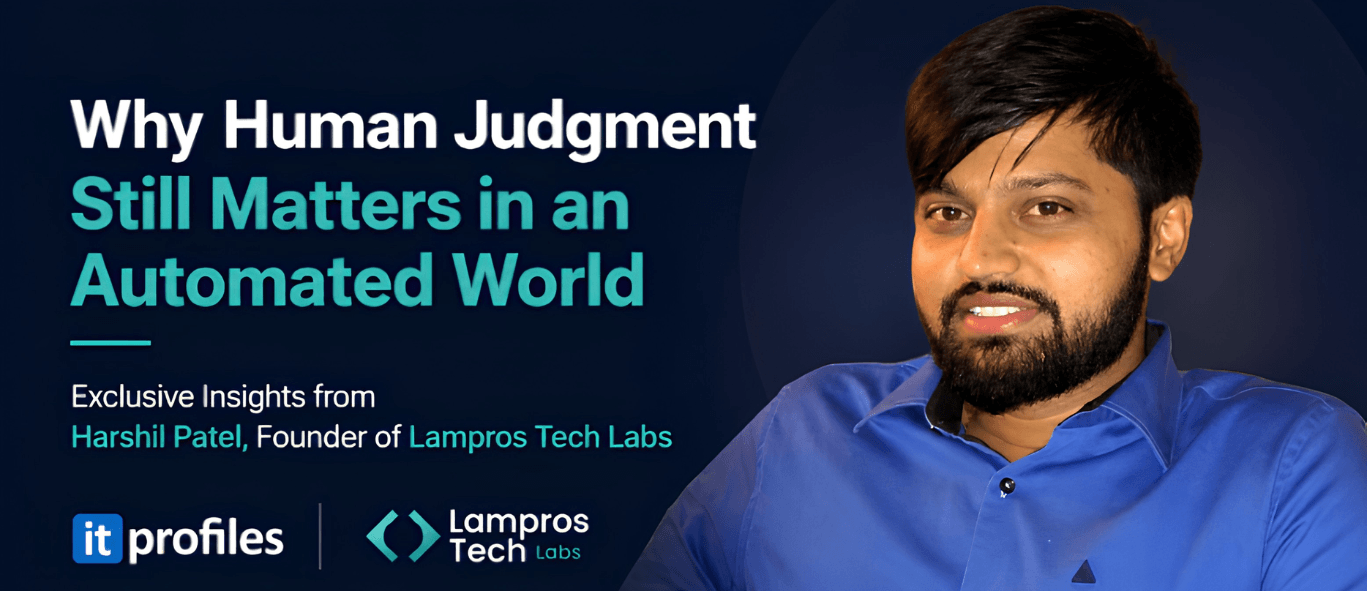
The conversation around automation often swings between two extremes: either technology will replace everything, or human expertise will somehow stay untouched forever.
Harshil Patel, Founder and CEO of Lampros Tech Labs, seems interested in neither narrative. In conversation with ITProfiles, he approaches the subject with a far more practical mindset: technology is powerful, useful, and unavoidable, but without human judgment, communication, and adaptability, it quickly becomes just another tool people overestimate.
What stands out in Harshil’s perspective is the lack of drama around the topic. There’s no fearmongering about machines taking over, and no exaggerated worship of “human-only” work either.
Instead, the focus stays grounded in something businesses care about far more: whether the work actually creates value, solves the right problem, and builds trust strong enough to survive when things get difficult.
The market is overflowing with affordable tools promising faster work, smarter automation, and instant results. Harshil Patel doesn’t deny that many of them are genuinely useful.
The problem, according to him, is that tools alone rarely solve business problems without someone experienced steering the process behind them.
“Tools still need people who know what to do with them.” That’s the part many companies underestimate. Buying access to software is easy. Knowing which tool fits the situation, how to adapt it properly, and where its limitations begin still takes human judgment.
Harshil compares it to everyday life. Most people could probably learn how to install a ceiling fan or assemble furniture after watching a few videos online. But in reality, they would rather call someone who already knows how to do it properly because time, confidence, and peace of mind matter too.
At Lampros Tech Labs, the value sits in that layer of clarity. Clients are not just paying for execution; they are paying for a team that keeps up with changing tools, filters out unnecessary complexity, and focuses on solving the actual problem instead of blindly following trends.
“AI helps reduce timelines, but a good human team makes sure the work actually solves the right problem.” And honestly, that difference is usually what separates quick output from work that businesses can genuinely rely on.
Harshil doesn’t believe most project failures happen because automation itself is fundamentally flawed. In many cases, the bigger issue is reliability. Teams build workflows around systems they assume will behave consistently, only to discover that performance can shift without warning underneath them.
“We have found agents not performing as intended for multiple projects.” That unpredictability becomes a real problem when businesses start depending too heavily on automated workflows without building safeguards around them. A process may work perfectly one week and suddenly slow down or lose accuracy the next because priorities changed somewhere higher up the chain.
The founder points out that many people forget these systems are still dependent on external providers, shared cloud infrastructure, and usage priorities. If access changes or performance drops, the workflow suffers immediately. And unlike human teams, the system itself usually cannot explain why the quality suddenly feels off.
At Lampros Tech Labs, this is where human oversight becomes essential. Automation may handle repetitive execution, but someone still needs to monitor performance, spot inconsistencies early, and step in before small technical gaps become business problems. Otherwise, companies end up trusting processes they no longer fully control, and honestly, that’s usually where trouble begins.
When projects become stressful, clients rarely want silence from the other side. They want clarity, reassurance, and most importantly, someone they can actually talk to. Harshil believes that human presence still matters most when things stop going according to plan.
“For every insight human is with whom the client talks and expect an explanation on what's going inside.” That expectation changes the dynamic completely. Even highly technical problems become easier to handle when clients feel there’s a real person actively guiding them through the uncertainty instead of hiding behind systems or automated replies.
At Lampros Tech Labs, communication during difficult moments is treated almost as seriously as the technical fix itself. Clients may not understand every backend issue, but they immediately understand honesty, responsiveness, and calm leadership. That emotional layer still builds trust faster than polished automation does.
At the same time, Harshil is realistic about where things may head next. “This could change in future and bot could be as persuasive as a human can be.” But for now, when stakes are high and pressure builds, people still look for something technology hasn’t fully replaced yet, the confidence that another human being is genuinely paying attention.
Harshil doesn’t believe software development is heading toward a future where “100% human-made” automatically becomes a premium badge. In his view, technology is simply evolving too fast for that kind of separation to hold for long.
“I don't think there should be 100% Human Strategy required.” The founder compares it to the industrial revolution, where machines transformed production but didn’t completely erase craftsmanship. Some handmade work remained valuable because certain tasks were still too nuanced or difficult to automate properly.
But software, according to Harshil, behaves differently. Unlike physical craftsmanship, development workflows can adapt rapidly to automation. The gap between what humans do manually and what systems can assist with keeps shrinking every year, making it harder to treat “human-only” as a long-term moat by itself.
At Lampros Tech Labs, the focus is less about resisting technology and more about using it intelligently. The value doesn’t come from avoiding automation entirely. It comes from knowing where human involvement genuinely matters and where systems can speed things up without hurting quality. And honestly, that balance is probably far more realistic than pretending software can stay handcrafted forever.
As technology keeps accelerating execution, Harshil believes the real differentiator is becoming surprisingly simple: honest communication. Not polished presentations. Not overengineered jargon. Just the ability to speak clearly, responsibly, and with integrity when clients need answers.
“Communication with integrity.” Short answer, but probably the hardest thing to scale properly. In fast-moving projects, trust is rarely built through perfect execution alone. It comes from consistency, saying what’s happening, being upfront when something changes, and not disappearing when things become uncomfortable.
At Lampros Tech Labs, this kind of communication is treated less like customer service and more like operational discipline. Clients can usually handle delays, pivots, or technical setbacks. What damages relationships is confusion, avoidance, or feeling like information is being filtered instead of shared honestly.
And honestly, that’s one thing automation still struggles to replicate convincingly. Systems can deliver updates, notifications, and summaries. But integrity is felt in tone, timing, accountability, and the willingness to have difficult conversations without hiding behind perfectly crafted responses.
Harshil answers this question with unusual honesty: “Figuring out.” And honestly, that answer probably feels more real than pretending anyone has fully solved it yet.
Right now, almost every brand is trying to sound authentic while using the same tools, the same formats, and often the same writing patterns. Standing out has become strangely difficult because audiences are getting better at recognizing overly polished advertising and marketing communication that feels manufactured.
At Lampros Tech Labs, the approach seems less about forcing a perfectly crafted brand personality and more about staying self-aware while the landscape keeps shifting. That willingness to admit the process is still evolving feels human in itself. Most people trust brands a little more when they sound like they’re learning instead of pretending they already have all the answers.
And perhaps that’s the bigger challenge ahead, not avoiding technology, but figuring out how to keep personality alive while using it. Because the moment every company starts sounding perfectly optimized, even a little uncertainty begins to feel refreshing.
Harshil believes the biggest limitation of automation is surprisingly simple: people change their minds constantly. Trends shift, expectations evolve, and public behavior rarely follows a perfectly predictable pattern for very long.
“Real time public needs.” That’s the part he feels systems still struggle to truly understand. Businesses survive because they solve what people want at a particular moment, but those wants are always moving. What works today may quietly stop resonating six months later without any obvious warning signs.
At Lampros Tech Labs, this is where human experimentation still matters. Much of business growth comes from testing ideas, failing quickly, adjusting direction, and learning through instinct as much as data. Humans have been operating through trial and error for generations, and that messy process often reveals opportunities before systems can fully recognize them.
The founder believes automation works best when patterns are already established. But understanding emerging behavior, especially before it becomes obvious, still requires observation, curiosity, and a willingness to take imperfect bets. And honestly, that unpredictability is probably what keeps business interesting in the first place.
Harshil’s answer to the idea of founder intuition being untouchable is surprisingly direct: “No.”
For years, instinct has been treated almost like a superpower in business, the idea that experienced founders can simply “feel” the right move before the market catches up. But at Lampros Tech Labs, the view seems more grounded. Intuition still matters, but it is no longer enough to treat it as some unbeatable advantage.
The founder appears to believe that systems are improving faster than people are willing to admit. Pattern recognition, prediction, and analysis are becoming increasingly sophisticated, which means relying purely on gut feeling without evidence can quickly become dangerous instead of visionary.
That doesn’t make human judgment irrelevant. It simply changes the role it plays. The strongest founders today are probably not the ones ignoring technology in favor of instinct, but the ones learning how to combine both without becoming overly dependent on either side.
Harshil looks at low-cost automated work the same way many industries look at raw ingredients: accessible, useful, but not automatically valuable on their own. The real difference appears when someone knows how to turn that base material into something people genuinely want.
“We can have peanuts available for all, but a great peanut butter is not made by every company.” Simple comparison, but it lands. Access alone doesn’t create quality. Plenty of businesses can use the same tools, prompts, and systems, yet still end up producing work that feels forgettable or interchangeable.
At Lampros Tech Labs, the belief seems to be that strategy is the layer that transforms commodity into value. Technology can speed up execution, but without strong thinking behind it, the result often stays average no matter how advanced the workflow looks on paper.
The founder also makes an important distinction: software is not just consumed like a product sitting on a shelf. Ideally, it creates measurable value for the business investing in it. And honestly, that’s usually why companies are willing to pay more, not for the process itself, but for the confidence that the end result will actually move something forward.
Harshil doesn’t believe the world is truly heading toward a fully bot-first future, no matter how advanced the technology becomes. In his view, human behavior has always pointed in the opposite direction.
“Humans for ages loves to be around humans.” Simple thought, but it explains a lot. Even in a digital world filled with remote work, automation, and endless convenience, people still naturally move toward connection, conversation, and shared experiences. Technology may change workflows, but it rarely changes human nature completely.
The founder points to something interesting: cities themselves. On paper, people gather in cities because of opportunity. But according to Harshil, opportunity is only part of the story. People also gravitate toward energy, interaction, community, and the feeling of being around other humans, even when it’s messy, noisy, or inefficient.
At Lampros Tech Labs, this creates a more balanced view of the future. Automation will absolutely continue growing because businesses need speed and scale. But emotionally, socially, and creatively, people still crave human interaction far more than they admit. And honestly, that’s probably why fully replacing people has remained harder than every generation of technology once predicted.

While automation tools can speed up execution and reduce timelines, they still require experienced humans to decide which tool fits the situation, how to adapt it correctly, and where its limitations begin. As Harshil Patel of Lampros Tech Labs explains, buying access to software is easy, but knowing how to use it to solve the right problem is where human judgment becomes irreplaceable.
Over-reliance on automation without human oversight can be dangerous. Automated systems can shift in performance without warning due to changes in external providers, cloud infrastructure, or usage priorities. Without someone actively monitoring and stepping in when inconsistencies arise, businesses can end up trusting processes they no longer fully control, and that's usually where problems begin.
Not entirely, at least not yet. Clients, especially during stressful or high-stakes moments, still expect a real person to explain what's happening and guide them through uncertainty. Harshil Patel notes that while bots may become more persuasive in the future, honest, responsive, and calm human communication still builds trust faster than polished automation does.
According to Harshil Patel, no. Unlike physical craftsmanship, software development workflows adapt rapidly to automation, and the gap between manual human work and AI-assisted work keeps shrinking. The real advantage lies not in avoiding automation entirely, but in knowing where human involvement genuinely adds value and where systems can speed things up without hurting quality.
Lampros Tech Labs focuses on the strategic layer that transforms commodity output into real business value. As Harshil Patel puts it, access to tools doesn't automatically create quality, much like how peanuts are available to everyone, but not every company makes great peanut butter. The differentiator is strong thinking, honest communication, and human oversight that ensures the work actually solves the right problem and delivers measurable results.
Built on Technology. Driven by People.
Learn how Lampros Tech Labs helps businesses get real value from technology without losing the human touch.
Let’s Talk