
COO @ Quorivex Systems
We wanted to automate a few workflows but weren't sure where to start. Lampros helped us cut through the noise and get something useful into production quickly.

CTO @ Teralynx Systems
They picked up our processes surprisingly fast and built around how we already worked instead of forcing us into a new system.

Financial Technology Company
We saw value pretty quickly. A lot of repetitive work that used to take hours every week simply stopped being a problem. Our team could focus on higher-value work instead.
Contact Us
Ready to Ship AI Systems to
Let's align architecture, execution, and delivery from day one.
Published On Jul 24, 2026
Updated On Jul 24, 2026

Every competitor can buy the same models you can. That is exactly why AI has produced so little advantage so far.
Most companies are investing in AI capability, which is a purchased input available to everyone at the same price.
AI competitive advantage comes from something else: how much real work you can safely hand to the system.
That is set by how well you understand the process, not by how good the model is.
This article covers where AI business value actually sits, how to choose which processes to automate, and how to measure AI ROI before it reaches the P&L.
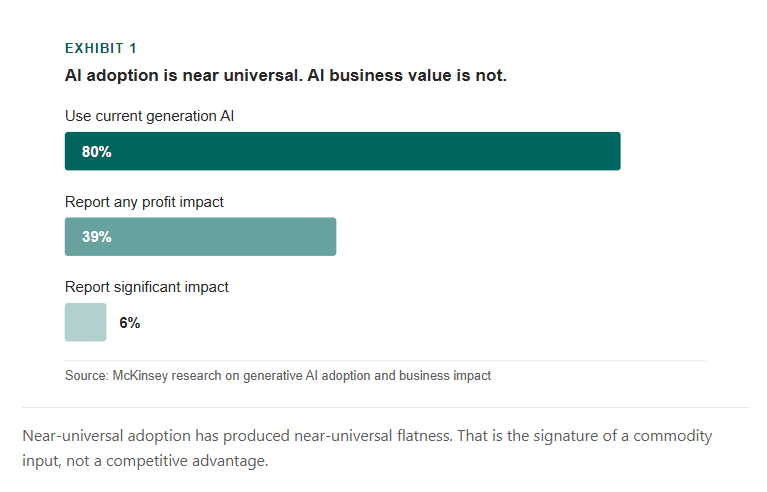
McKinsey research found that 80% of companies report using the latest generation of AI, and the same percentage have seen no significant gains in topline or bottom-line performance.
That is a strange result. When a technology is genuinely transformative, early adopters usually pull ahead.
Here, near-universal adoption has produced near-universal flatness.
The usual explanation is that it is early. That is partly true and mostly a dodge. A better explanation is sitting in the numbers.
If everyone can buy the same capability at the same price, capability cannot be the source of advantage. It is a cost, and costs do not differentiate.
The companies reporting gains are not the ones with better models. They are the ones who did something with the model that their competitors could not copy.
In its State of AI survey, out of 25 organisational attributes tested, the redesign of workflows had the biggest effect on an organisation's ability to see EBIT impact from generative AI.
High performers were roughly three times more likely to have fundamentally redesigned their workflows.
Redesigning a workflow is slow, specific and hard to copy. Buying model access takes an afternoon.
It helps to separate the parts of an AI system by who else has them.
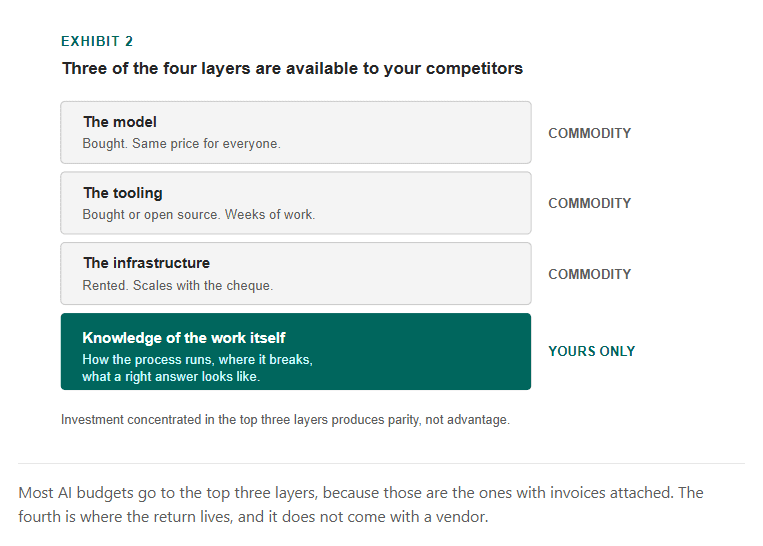
Most AI budgets go to the top three layers, because those are the ones with invoices attached. The fourth is where the return lives, and it does not come with a vendor.
Which raises the harder question. If the value sits in a layer you cannot buy, how do you tell whether you are building it?
Measure AI business value by how much work the system completes without rework, not by accuracy or adoption.
Track three things: the share of output that stands as produced, the fully loaded cost per completed unit against your manual baseline, and the time from decision to running in the business.
Here is a more useful way to value an AI system than accuracy or adoption.
How much consequence can you safely hand it?
A system that drafts something a person rewrites carries almost no consequence, and returns almost no value.
A system that completes work and it stands, with a person spot-checking, carries real consequence and returns real value.
The gap between those two states is where the money is.
What moves a system from the first to the second is not model quality. It is how precisely you have defined the work. Like -
That definition is the asset. It takes months to build, it is specific to your business, and a competitor cannot buy it.
This reframes the investment question. You are not buying a capability. You are buying the ability to remove yourself from a piece of work. Price it that way.
Most AI programmes fail at portfolio construction, not execution. They run many small pilots across many departments, because that looks like momentum and spreads political risk.
It also guarantees that no single workflow gets understood well enough to hand real consequence to. Twelve shallow pilots produce twelve systems nobody trusts.
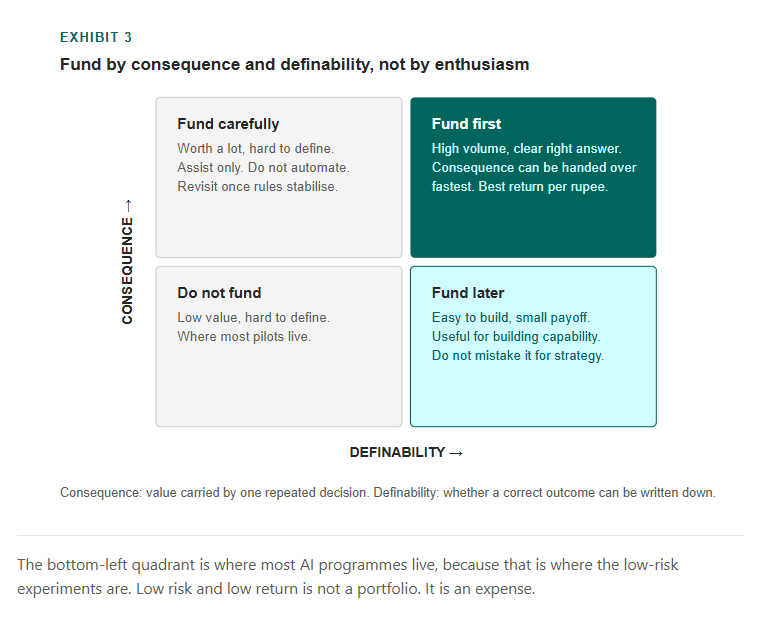
Two variables should drive selection.
Consequence density. How much value sits in one repeated decision. High volume, high error cost, high labour intensity. Low value per instance is fine if the instances are constant.
Definability. Can you write down what a correct outcome is. Processes with stable rules and clear right answers can absorb consequence quickly. Judgement-heavy processes cannot, however capable the model is.
This is also the practical dividing line between what suits AI agents and workflow automation and what is better served by retrieval-augmented generation, where the system surfaces the right information and a person still decides.
AI investments are usually judged on adoption. Seats used, prompts run, teams onboarded. Those measure enthusiasm.
Three measures tell you something real, and all three move before the P&L does.
Share of work completed without rework. Not accuracy in testing. The proportion of real output that stands as produced. This is the direct measure of consequence transferred.
Cost per completed unit, fully loaded. Total monthly cost, including review time, divided by items that passed. Compare to the manual figure. If you did not record the manual figure first, you have made this unanswerable, which is the most common reason AI programmes cannot prove value.
Time from decision to running. How long from choosing a workflow to it operating in the business. This is your organisational metabolism, and it predicts every future AI investment you make.
IBM's C-suite research found that only 25 percent of AI initiatives have delivered the expected return and just 16 percent have scaled enterprise-wide.
A large share of that is not failed technology. It is unmeasured technology.
The strategic risk in AI is asymmetric. A system that works saves a known amount. A system that fails badly can cost an unknown one.
Gartner expects over 40% of agentic AI projects to be canceled by the end of 2027 due to escalating costs, unclear business value or inadequate risk controls.
The way to hold that asymmetry is to treat each investment as an option rather than a commitment. Small defined bet, capped downside, expanded only on evidence.
Three rules that follow
Automate after you assist, not before. Pilots that attempt full automation of a human task from the outset face a higher production failure rate than those that begin with AI-augmented human decision-making and move toward automation progressively.
Handing over consequence gradually is not timidity. It is how you find out what the system gets wrong while it is still cheap.
Decide where the data lives before you decide anything else.
Mayfield's 2026 CXO AI Survey of 266 technology leaders found the top blocker is not technology at all. It is data quality and integration. That is a design decision made at the start or a rebuild made later.
Give every system a kill condition at funding. Written down, agreed, and owned by someone with the authority to use it. A project without a stopping rule does not stop. It just gets quieter.
Each of those rules needs an owner with the authority to enforce it. Deciding who that is has become harder than it used to be.
One structural change is worth planning for. Mayfield found that line of business leaders are now the largest decision maker group at 46 percent, surpassing both CIOs and CTOs at 38 percent.
That is the right direction and it creates a problem. The people who best understand the work now control the budget, and they cannot judge whether a system is safe to hand consequence to. The people who can judge that no longer control the budget.
Companies that resolve this by giving the technical team a veto will move slowly. Companies that resolve it by letting the business side buy freely will accumulate systems nobody can support.
The resolution that works is joint ownership with separated rights. The business owner sets the outcome and holds the kill switch. The technical owner holds a veto on what the system is allowed to do. Neither can proceed alone.
Setting that up takes time, which raises the question most boards are really asking. Is there still time?
There is a timing argument here, and it runs opposite to the usual one.
Because capability is a commodity, it gets cheaper and better while you wait. That means the cost of a late start is falling, not rising, on the technology side.
But the definition work does not get cheaper. Understanding your own processes deeply enough to hand them over takes the same months whenever you start. And it compounds, because each workflow you define teaches you how to define the next one faster.
Advantage does not go to whoever adopts AI first. It goes to whoever starts learning their own operations first.
That clock started some time ago, and it does not reset when the next model ships.
The 80 percent who report no gains are not doing AI badly. Most are doing it exactly as sold, buying capability and expecting returns.
The returns are one layer down, in work that has no vendor and no procurement process. Understanding a process well enough to define what right looks like. Bounding what the system may do. Handing over consequence in steps, measuring what comes back, and stopping the ones that do not pay.
That is unglamorous, and it is why so few companies have done it. Which is precisely why it is still worth something.

Because most investment goes into capability, which every competitor can buy at the same price. Returns come from the work of defining your own processes well enough to hand them over, which nobody can buy for you.
Score them on consequence, meaning the value carried by one repeated decision, and definability, meaning whether you can write down what a correct outcome looks like. Fund the ones that score high on both.
Track share of output that needs no rework, fully loaded cost per completed unit against the manual baseline, and time from decision to running.
Start with a person checking. Automating fully from day one has a higher failure rate than assisting first and automating as evidence accumulates.
Split the rights. The business owner sets the outcome and holds the authority to stop it. The technical owner controls what the system is allowed to do. Neither proceeds alone.
Ready to take one process from demo to production?
Tell us about one manual workflow slowing your team down. We will show you how it could be automated, built for production, not a throwaway demo.
Book an AI strategy call